
Why Does My Body Feel Tense All the Time? A Guided Ho'oponopono Prayer to Forgive Your Body
By Meghalatha Gopal · 28 Oct 2026
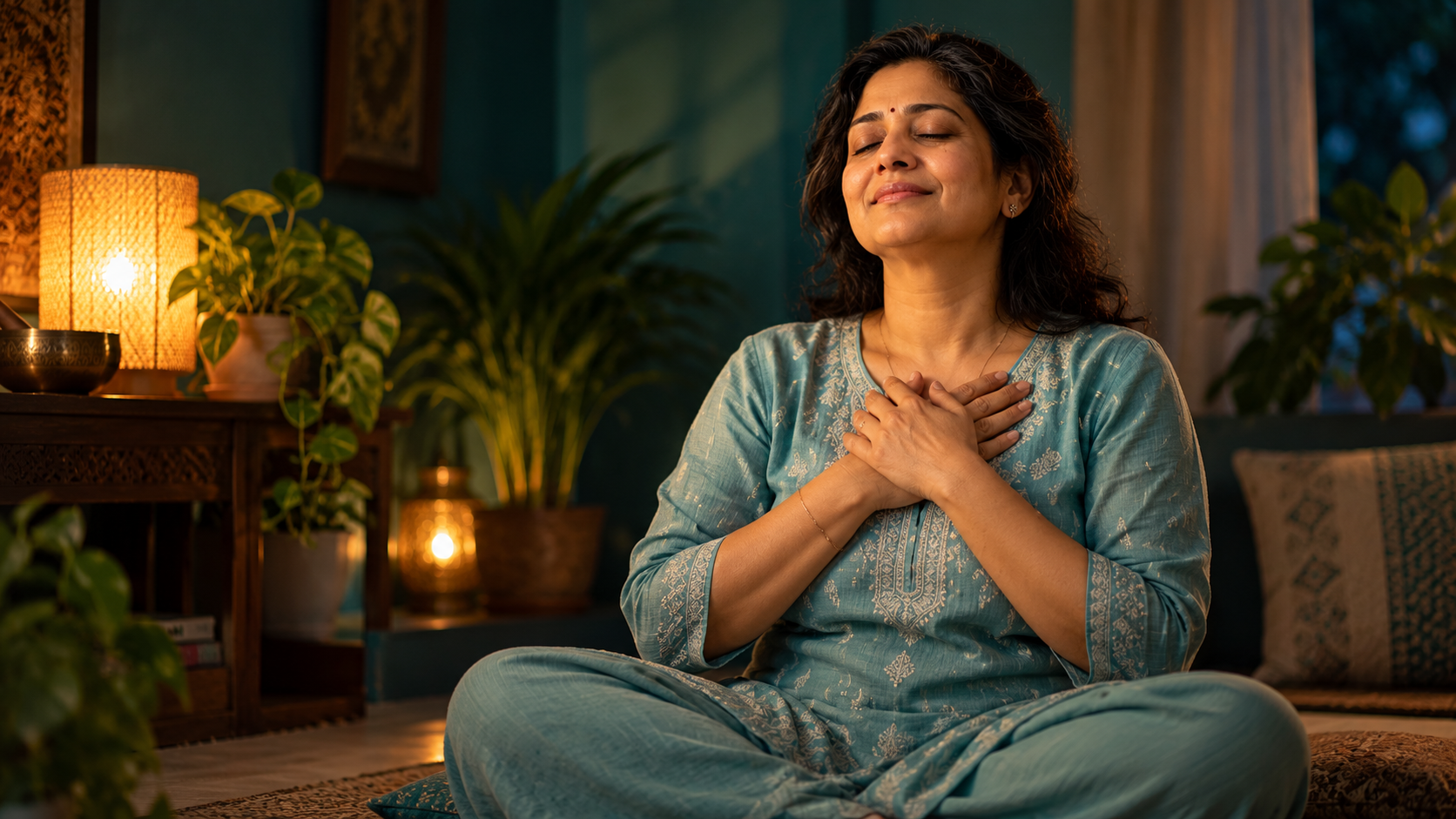
Have you ever noticed that your shoulders are up near your ears even when you are just sitting and watching television? Or that your jaw feels tight when you wake up in the morning, as if you were clenching it all night?
Many of us carry this tension for months, sometimes years, without really noticing it. We get used to it. We think, "It is just my age," or "I must be sitting badly." And we get on with the day.
In this article, let us look at why the body holds on to stress, and let us try a gentle practice that most of us were never taught: saying sorry to our own body, thanking it, and allowing some of that stored tension to soften, with a simple guided Ho'oponopono prayer.
Guided video: Forgive Your Body — coming on 29 Oct
Why does the body hold on to stress?
Think about an ordinary day for many women between 35 and 55. You wake up and the first thought is about breakfast, tiffin boxes and who needs to leave at what time. There is office pressure, and then there are responsibilities at home. There are children, ageing parents, and family expectations. Maybe somebody at home makes a comment, and you decide it is better not to reply. By night, while preparing dinner and checking whether everyone has eaten, you may notice that you have not really sat down all day.
Every time we say "I'm fine" when we are not fine, or swallow words we wanted to say, the body may tighten a little. Over time, this often shows up as stiff shoulders, a clenched jaw, a heavy feeling in the chest, a lower back that aches by evening, or a stomach that always feels slightly knotted.
When perimenopause arrives, hormones shift and sleep often becomes lighter. Perhaps the body has even less room to hold all of this, and so the tension becomes easier to notice.
A gentle reminder here: if your pain is new, severe or getting worse, please do see your doctor. Body pain can have medical causes that need to be checked, and this practice is meant to support your medical care, never to replace it.
It is time to bust a few myths
Myth one: forgiveness is only about other people
We usually think of forgiveness as something we offer to a husband, a mother-in-law, a friend or a boss. But very often, the person we are hardest on is ourselves. We criticise our weight, our skin, our energy, our sleep. Perhaps the body hears every one of those words.
Myth two: this tension is only bad posture or age
Posture does play a part. But when we live under stress for a long time, the muscles may stay slightly braced, as if we are always ready for the next thing. This is often about the nervous system, and not only about the spine.
Myth three: you need hours of therapy or an expensive retreat to let go
Sometimes, what the body needs first is something very simple: attention, kindness and slow breathing. That is what we will do here.
How my RRR Method applies here
Release: we use the four Ho'oponopono phrases to release what each part of the body has been holding.
Rebalance: we breathe into the heart, the heart chakra or Anahata, which is traditionally linked with compassion, so the nervous system has a chance to settle.
Rise: we give the body a new, kinder message to carry forward, in place of the old stress.
The four Ho'oponopono phrases

Ho'oponopono is a Hawaiian practice of reconciliation and forgiveness. In its simplest form, it uses four phrases: I'm sorry. Please forgive me. Thank you. I love you.
In this practice, we do not say them to anyone else. We say them to our own body.
- "I'm sorry" for the times I ignored you, pushed you and criticised you.
- "Please forgive me" for not listening sooner.
- "Thank you" for carrying me anyway.
- "I love you" because you are mine, and you deserve kindness.
You can say them aloud or silently. If they feel a little strange in the beginning, that is completely normal. You do not have to believe them yet. You only have to say them and notice how you feel.
A guided Ho'oponopono prayer to forgive your body
Sit comfortably, or lie down. Close your eyes if that feels safe for you. Breathe in through your nose for a count of four, and breathe out slowly for a count of six. Do this three times.
Round 1: jaw and shoulders
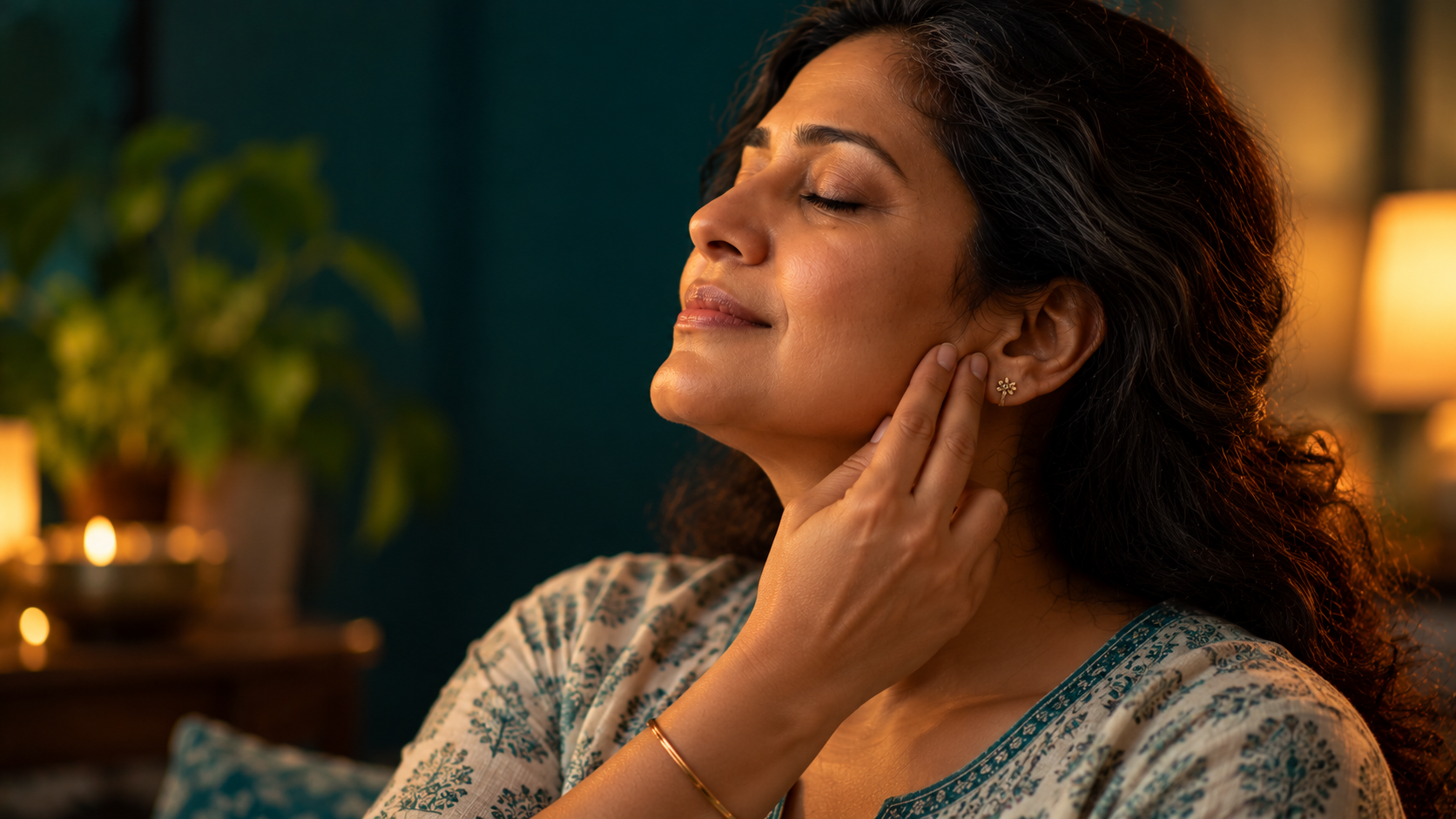
Place your fingertips gently on the hinge of your jaw, just in front of your ears. Let your teeth part a little and let your tongue rest. Slowly say: I'm sorry for all the times I held you tight. Please forgive me. Thank you for holding my words when I could not say them. I love you.
Now cross your arms and rest your hands on your shoulders, like a gentle hug. Your shoulders carry so much responsibility. Say: I'm sorry for making you carry so much. Please forgive me. Thank you for staying strong for me. I love you. Breathe out, and allow your shoulders to move down, away from your ears.
Round 2: belly and lower back
Place one hand on your belly and the other on your lower back. This is where many of us hold worry, like that knot before a difficult phone call. To your belly, say: I'm sorry for every time I criticised you, held you in, or wished you were smaller. Please forgive me. Thank you for digesting not just my food, but my worries. I love you.
Then, to your lower back: I'm sorry for making you hold up everyone and everything. Please forgive me. Thank you for supporting me every single day. I love you.
Optional: a short EFT tapping round
If you already know EFT tapping, you may gently tap the karate chop point, the soft side of the hand below the little finger, and say three times: "Even though my body has been holding years of stress, I deeply and completely love and accept myself." Then say the four phrases once more while tapping. If you do not know tapping yet, simply keep your hands on your belly and breathe. You are not missing anything.
Round 3: the whole body and the heart
Bring both hands to the centre of your chest. You may imagine a soft green light here, slowly spreading through your whole body. Say to your whole body: Dear body, I'm sorry. Please forgive me. Thank you. I love you.
Then give your body a new message: "From today, I will listen to you. I will rest when you ask. You are safe with me." Take three slow breaths, and open your eyes when you are ready.
What if tears come?
Sometimes, when we speak kindly to a part of the body that has carried stress for a long time, tears may come. Or a deep sigh, a yawn, or a gurgle in the stomach. Many women find this is simply the body letting go. Let it be, drink a glass of water, and be gentle with yourself for a few minutes. If strong emotions come up often, or feel difficult to manage, please reach out to a qualified counsellor or your doctor.
How this typically works
The first time, many women feel a little lighter, and sometimes a little emotional. By the third or fourth day, you may start noticing where you hold tension during the day: in traffic, during a difficult conversation, or while cooking with a hundred things on your mind. And you may begin to catch it earlier.
That noticing is often the real shift. The tension does not usually disappear overnight, because it did not arrive overnight. This is not a cure or a magic solution. Use it and see how you feel. Many women find that, with regular practice, the body slowly learns that it is safe to soften.
Your seven-day plan

- Days 1 and 2: jaw and shoulders only, for about five minutes, in the morning or evening.
- Days 3 and 4: add the belly and lower back.
- Day 5: add the karate chop tapping, if you would like to.
- Day 6: practise once with your eyes open in the middle of your day, in the kitchen or at your desk. Just one round of the four phrases wherever you feel tight.
- Day 7: do the whole practice, all three rounds, and write down one sentence about how your body feels compared to day one.
Frequently asked questions
What is a Ho'oponopono prayer for the body?
It is a way of using the four Ho'oponopono phrases, "I'm sorry, please forgive me, thank you, I love you", and directing them to your own body instead of to another person. It is a gentle practice of self-forgiveness and attention.
Does Ho'oponopono work if I don't believe in it?
You do not need to believe it for the practice to be worth trying. Many people find that the body responds to slow breathing and a kind tone before the mind agrees. Try it for seven days and see how you feel.
How long should I practise each day?
Five to fifteen minutes is enough. Regular short practice is usually more helpful than one long session.
Can Ho'oponopono replace medical treatment for pain?
No. It is a self-care practice that may help you relax and reconnect with your body. If you have pain that is new, severe or getting worse, please see your doctor.
Begin gently
If this practice touched something in you, you may like my free guide, 5 Things Every Woman Over 40 Should Know About Her Body.
If you would like to talk about what your body is going through, you can book a free clarity call with me, or simply message me on WhatsApp.
Take care of yourself.
This work supports emotional wellness and is not a substitute for professional medical care.