
Why Can't I Lose Weight After 40?
By Meghalatha Gopal · Self-Healing Mentor & Author of Your Body Is Speaking
Why Doesn't the Same Diet Work Anymore?
Have you ever wondered why the exact same diet that worked for you at 30 does absolutely nothing for you at 45?
Same food, sometimes even less food. Same workouts, sometimes harder workouts. And yet the scale doesn't move — or worse, it creeps up, especially right around your middle.
If that's you, I want to say this clearly: your body is not working against you. It is communicating with you, responding to a completely different set of internal conditions than it used to.
So many women tell me, "Megha, I'm doing everything right and nothing is working." I want you to know — you're very likely not doing anything wrong. Your body's internal chemistry has shifted, and this article goes deeper than most explanations, because this topic has more layers than people usually realise.
Prefer a shorter read? See our earlier article: The Real Reason You Can't Lose Weight After 40

Can You Relate to This?
- Weight settling around the middle without any real change in eating
- Stronger hunger and cravings than you remember having before
- Same exercise routine, noticeably different results
- Frustration, even shame, about how your body is responding
- A feeling that your metabolism has simply "stopped listening" to you
What May Be Happening in Your Body (Simple Science)
The Cortisol Foundation
Weight gain in your 40s and 50s is rarely just calories in versus calories out. Underneath it, one hormone plays an outsized role: cortisol, your stress hormone.
Think of cortisol like a pressure cooker's steam valve — useful in short bursts, releasing pressure exactly when needed. A workout, a deadline, a difficult conversation: cortisol rises, helps you through it, then settles back down. The problem is chronic, low-grade stress that never fully switches off. When that happens, cortisol stays elevated for years, not minutes.
Chronically elevated cortisol tells your body one thing very clearly: we are in danger, hold onto fat stores for survival — particularly around your abdomen. It also increases cravings for high-sugar, high-fat foods, disrupts sleep, and slows the metabolism because your body is prioritising protection over efficiency. And declining estrogen in this life stage makes your body more sensitive to cortisol's effects, shifting fat storage further toward the middle.
This is a hormonal and nervous-system shift, not a discipline problem.
The Blood Sugar and Insulin Loop (Going Deeper)
Here's where we go further than the usual explanation. Cortisol doesn't work alone — it works hand in hand with something most women have never even heard connected to their weight: insulin.
Here's the mechanism, step by step, because understanding it changes everything.
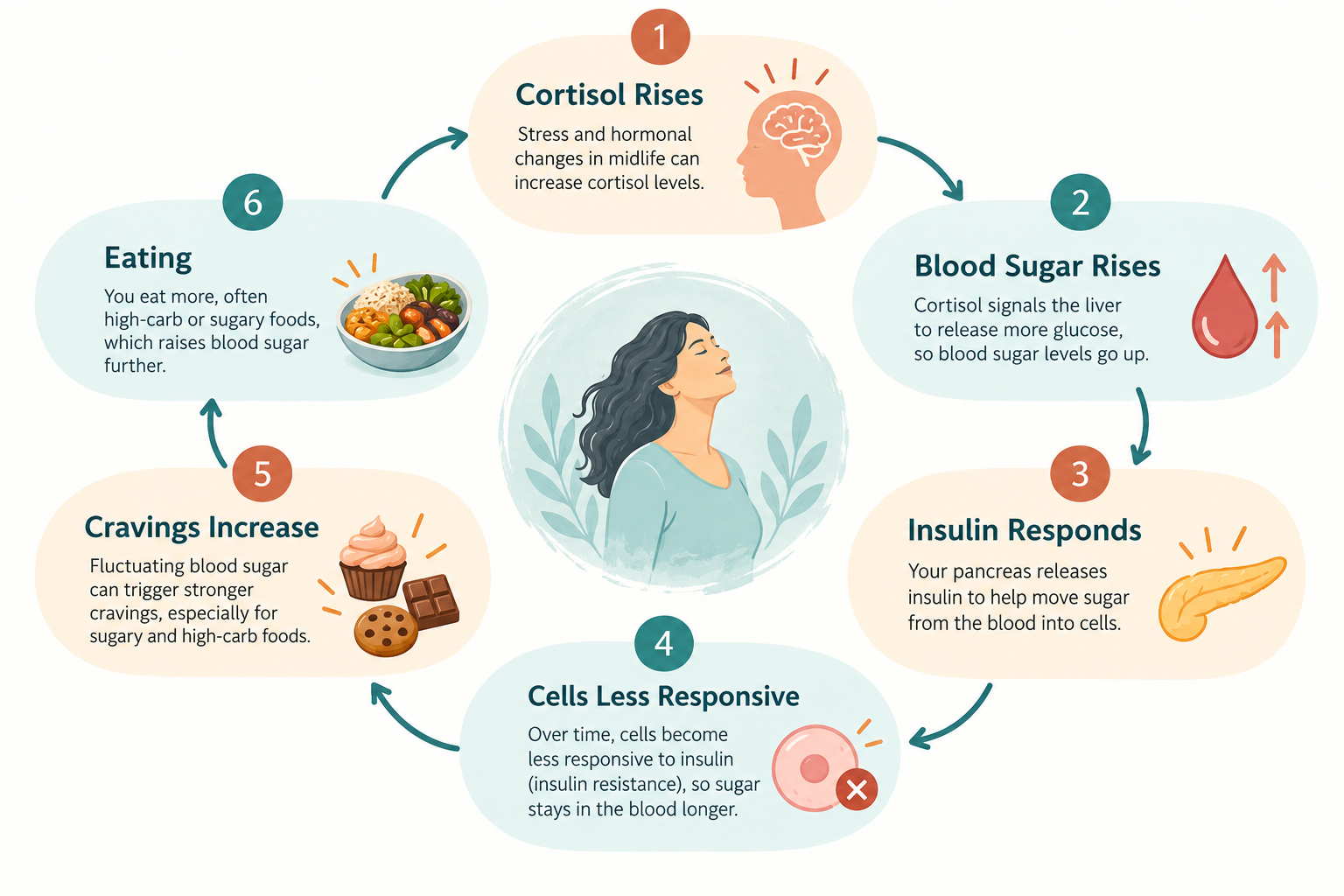
When cortisol is chronically high, it raises your blood sugar, because your body believes you need fuel to fight or flee. Your pancreas responds by releasing more insulin to bring that blood sugar back down. Over months and years of this pattern repeating, your cells can become less responsive to insulin — a pattern called insulin resistance.
Insulin resistance works against weight loss in two specific ways. First, it makes it much easier for your body to store fat, especially around the middle. Second, it makes you hungrier, faster, because your cells aren't receiving the fuel signal properly even though there is plenty of sugar in your blood.
The result is a loop: cortisol raises blood sugar, insulin rises to manage it, cells become less responsive over time, hunger and cravings increase, you eat, blood sugar spikes again, cortisol responds again. Round and round. This is the actual cravings loop, and it has almost nothing to do with willpower.
Why Muscle Mass Matters More Than You Think
After 40, and especially through perimenopause, women naturally begin losing muscle mass more quickly if it isn't actively maintained. This matters enormously for weight, because muscle is metabolically active tissue — it burns energy even at rest. Less muscle means a quietly slower metabolism, even if your weight on the scale hasn't changed yet.
This is exactly why the goal isn't less movement — it's the right kind of movement, which the practices below will cover.
The Sleep Connection, One Layer Deeper
Broken or shortened sleep doesn't just make you tired. It directly raises cortisol the very next day, and it also increases a hunger hormone called ghrelin while lowering leptin, the hormone that signals fullness. A bad night's sleep can quietly set up a harder day of cravings and fat storage before you've even had breakfast.
“Supporting your metabolism starts with calming your nervous system, not punishing your body.”
Common Myths About Weight Loss After 40
Myth 1: "I just need to eat less and move more."
For a body already running high cortisol and disrupted insulin sensitivity, cutting calories further, or adding more intensity, can raise stress hormones even more and work directly against you.
Myth 2: "My metabolism is just broken now."
It hasn't broken — it has adapted to a nervous system under prolonged stress. Real, gentle shifts happen once cortisol and nervous-system regulation are addressed alongside nutrition and movement.
Myth 3: "Strength training will bulk me up, so I should stick to cardio."
Especially after 40, resistance and strength-based movement is one of the most protective things you can do for your metabolism, because it directly supports the muscle mass that keeps your metabolism active.
Myth 4: "My cravings just mean I lack discipline."
Your cravings are very often a direct biochemical signal from the cortisol-blood sugar-insulin loop described above, not a character flaw.
The Self-Healing Framework: RRR for Sustainable Weight Balance
Release — Give your nervous system a genuine outlet for stress, so cortisol has less reason to stay chronically elevated in the first place.
Rebalance — As your nervous system calms, your blood sugar and insulin patterns have a real chance to stabilise, which softens the cravings loop from the inside.
Rise — With a calmer internal environment and the right kind of movement supporting your muscle mass, your body becomes far more responsive to the nutrition and activity choices you're already making.
Two Practices You Can Try Today
1. The 60-Second Calming Pause (before a meal)
- Sit down — don't eat standing or rushed.
- Take 3 slow breaths, exhaling longer than you inhale.
- Silently say: "I am safe. I can nourish my body."
- Begin eating slowly, noticing the first few bites.
This shifts your nervous system out of stress mode before you eat, supporting better digestion and blood sugar response.
2. The 10-Minute Post-Meal Walk
A short walk after your largest meal of the day — not before — helps your muscles take up glucose from your bloodstream more efficiently, meaning less of the blood sugar spike that triggers the cortisol-insulin cycle described above. A small, gentle habit with a surprisingly direct effect on the loop.
Key takeaway: Weight balance after 40 isn't about trying harder — it's about lowering your nervous system's overall reactivity so your body's own systems can respond the way they're designed to.

How This Typically Works: A General Pattern I See
Rather than sharing one individual's story, I want to walk you through the pattern I see again and again with women in this stage, because it may feel familiar to you.
Most women who reach out have already tried the conventional approach — eating less, exercising harder — and found it simply stopped working, sometimes even backfired. There's usually real hesitation to try something different, because everything they've been told suggests they should try even harder.
What I typically see next is this: once the approach shifts — regulating the nervous system first, adding gentle strength-based movement instead of more intensity, and protecting sleep — the pattern usually starts changing within a few weeks. Not dramatic overnight change, but steadier energy, softer cravings, and importantly, a shift away from feeling like their body is the enemy. Many women describe it as the first time in years they don't feel like they're at war with their own body.
Common Mistakes Women Make With Weight After 40
- Adding more intense exercise when the body is already under stress
- Cutting calories further, which can raise cortisol and cravings rather than resolve them
- Blaming themselves instead of understanding the underlying hormonal shift
- Ignoring sleep and stress while focusing only on food and exercise
- Avoiding strength-based movement out of a fear of "bulking up"
- Skipping the post-meal movement window that helps regulate blood sugar
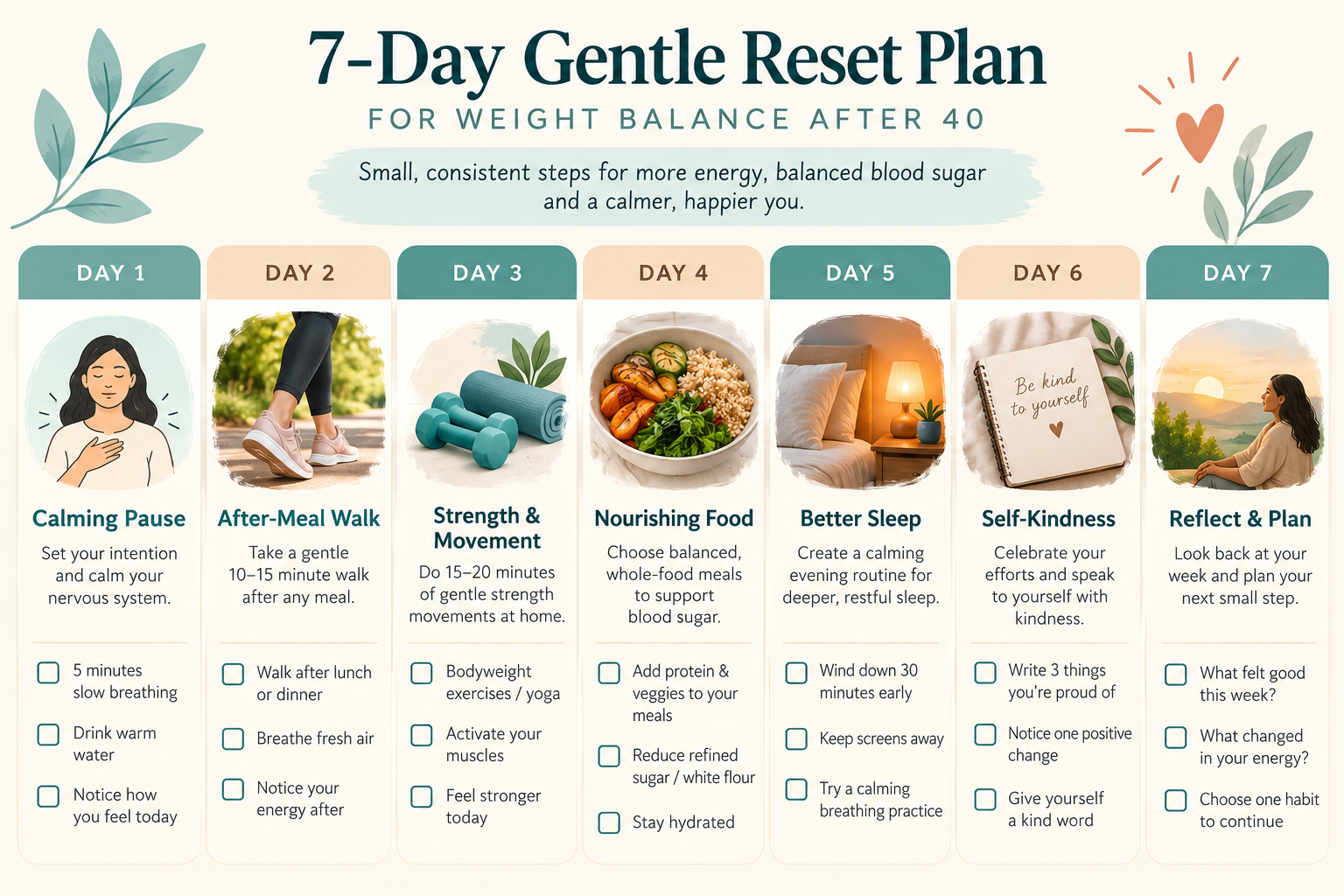
Your 7-Day Gentle Reset Plan
- Day 1–2: Practice the 60-second calming pause before each meal
- Day 3: Add the 10-minute walk after your largest meal of the day
- Day 4: Swap one high-intensity workout for gentle strength-based movement, even simple bodyweight exercises at home
- Day 5: Go to bed 30 minutes earlier than usual, protecting your hormone reset overnight
- Day 6: Notice one moment of self-criticism about your body, and consciously replace it with a kinder thought
- Day 7: Reflect on how your body felt this week, separate from what the scale says
Frequently Asked Questions
Can stress alone cause weight gain?
Chronic stress raises cortisol, which influences fat storage, cravings, and sleep over time.
Should I stop exercising if it's stressing my body?
Not necessarily — gentle, consistent movement like walking, yoga, or strength training is more supportive; if fatigue makes movement difficult, restoring energy first tends to help.
Do I need to see a doctor?
Yes — it's worth checking thyroid function and other relevant markers alongside making lifestyle changes.
Will eating less speed up results?
Often the opposite — significant calorie restriction can further elevate stress hormones in an already-stressed body.
How is menopause connected to belly weight?
Declining estrogen shifts fat distribution toward the abdomen and increases sensitivity to cortisol.
Can better sleep affect weight?
Yes — poor sleep raises cortisol and the hunger hormone ghrelin while lowering leptin, the fullness hormone, regardless of diet.
Why do I crave sugar more than I used to?
Elevated cortisol and fluctuating blood sugar intensify cravings for quick-energy foods.
What exactly is insulin resistance?
It's when your cells become less responsive to insulin's signal, making it easier to store fat and harder to feel satisfied after eating.
Does walking after meals really make a difference?
Yes — a short walk after eating helps muscles absorb glucose from the bloodstream, reducing the blood sugar spike that can trigger cravings later.
Why does strength training matter more after 40?
It helps maintain muscle mass, which is metabolically active tissue that keeps your resting metabolism from quietly slowing down.
Is it normal to lose muscle without noticing?
Yes — muscle loss after 40 can happen gradually and isn't always reflected on the scale right away.
Can poor sleep alone cause weight gain, even with a good diet?
Yes — the hormonal effects of poor sleep on cortisol, ghrelin and leptin can work against weight goals independent of what you eat.
Is intermittent fasting a good idea at this stage?
It depends on the individual — for some women with already-elevated cortisol, aggressive fasting can add stress; this is worth discussing with your doctor.
Why did my old diet stop working?
Your hormonal environment has changed — the same calorie or food approach interacts differently with a body running higher cortisol and different insulin sensitivity.
Can emotional eating be connected to cortisol?
Yes — cortisol-driven cravings often overlap with emotional eating patterns, since both involve the body seeking quick comfort or energy under stress.
Should I avoid carbohydrates completely?
Not necessarily — the concern is more about blood sugar spikes and timing than carbohydrates themselves; consult a nutrition professional for personalised guidance.
How long before I notice a difference with these practices?
Many women notice steadier energy and softer cravings within a few weeks of consistent practice, though timelines vary.
Does alcohol affect this cycle?
Alcohol can affect blood sugar regulation and sleep quality, both of which interact with the cortisol-insulin loop described above.
Is this the same as adrenal fatigue?
The terms overlap in popular use; the mechanism described here is about chronic cortisol elevation and its downstream effects, which is a bit different from how ‘adrenal fatigue’ is often used online.
Can this cycle happen even if I'm not consciously stressed?
Yes — the nervous system can carry chronic, low-grade stress that isn't consciously felt as ‘being stressed,’ especially when it's been the norm for years.
What's the single most helpful first step if I don't know where to start?
Begin with the 60-second calming pause before meals for one week. It's small, specific, and it's the foundation the rest builds on.
If You Don't Want to Figure This Out Alone
If this cycle has been quietly running your body for years — the frustration, the self-blame, the feeling that nothing works anymore — please know you don't have to sort through it by yourself.
I'd love to support you through a Free Clarity Call, where we can look at your specific pattern together. Or, you can begin right now with my free guide, "5 Things Every Woman Over 40 Should Know About Her Body."

What You Can Do Next
- Practice the 60-second calming pause daily this week and notice what shifts.
- Download the free guide 5 Things Every Woman Over 40 Should Know About Her Body to understand what your body is trying to tell you.
- If you would like personalised support, book a free clarity call with me at meghalatha.com.
- Read the metabolism and hormones chapter of Your Body Is Speaking for the complete midlife picture.
(Once this article has been live a while, share in the comments which of the 7-day practices made the biggest difference for you.)
A Warm Message From Meghalatha
Your body has not stopped listening to you. It has simply started listening to a different set of signals — cortisol, blood sugar, sleep, and muscle — and once you understand that language, you can finally work with your body instead of against it.
Healing doesn't happen because we know more. It happens because we gently practice what truly supports our body, in a consistent manner.
You are much, much more powerful than what you think you are. Take care of yourself today.
References
This work supports emotional wellness and is not a substitute for professional medical care.