
Is This Perimenopause or Depression? A Woman's Guide to Understanding the Difference
By Meghalatha Gopal · Self-Healing Mentor & Author of Your Body Is Speaking

"Is this perimenopause? Or is this depression?"
If you have typed that exact phrase into Google at midnight, you are far from alone. It is one of the most common — and most under-answered — questions in women's health.
From the inside, the two can look almost identical. The fatigue that sleep never seems to fix. The irritability that feels far bigger than the moment that triggered it. That strange emotional flatness, as though you are watching your own life through glass. For many women it shows up first as the mood swings that make you feel like a different person.
So many women tell me, "Megha, I don't feel like myself, and I don't even know what to call this." You deserve a clearer answer than "it's just your age."
“Estrogen does far more than regulate your cycle — it directly influences the same brain chemicals antidepressants are designed to target.”
Can you relate to this?
- Fatigue that no amount of sleep seems to fix
- Irritability that feels bigger than the moment
- Brain fog and trouble concentrating
- Low mood that seems to come from nowhere
- A quiet sense of not feeling like yourself anymore
- Wondering whether this is "just hormones" or something more
What may be happening in your body
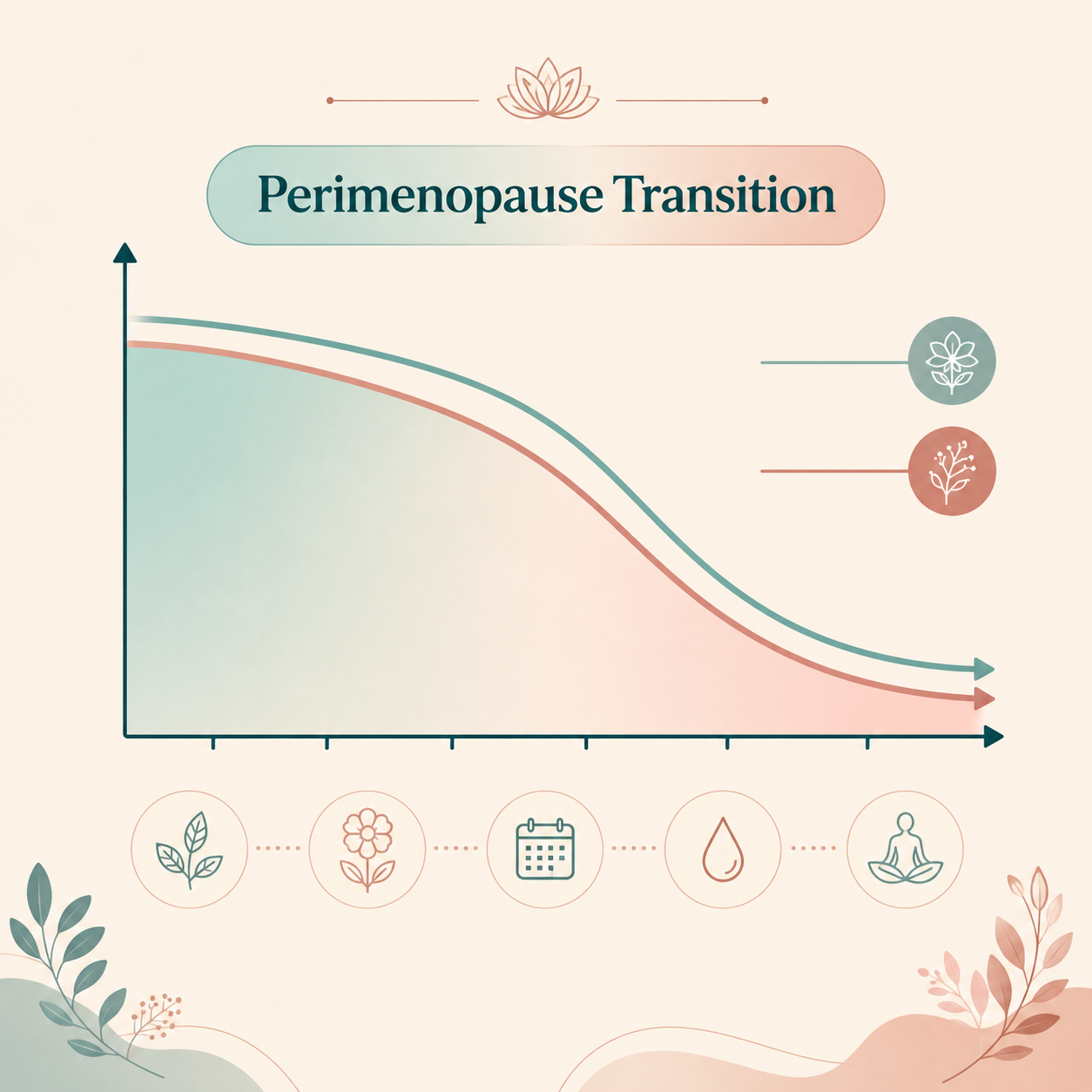
Perimenopause is the hormonal transition that comes before menopause. For most women it begins somewhere in the mid to late 40s, though for some it can start as early as the mid-30s. It is driven by declining and fluctuating estrogen and progesterone.
Here is the part very few women are told: those hormones do not only shape your cycle. They influence serotonin, dopamine and GABA — the very neurotransmitters that depression treatment targets. When estrogen dips and rises unpredictably, mood, motivation and calm dip and rise with it. This is also where the brain fog that often travels with it comes from. These same hormonal shifts also show up as the changes in your body you did not ask for — weight, temperature, sleep — which is why the question can feel so confusing.
That is why perimenopause and depression can feel so similar. They are not the same thing, but they share a great deal of the same biological ground.
Common myths about perimenopause and depression
"It's just hormones, it'll pass on its own."
Sometimes that is true. Often it is simply dismissive. If depression is layered underneath the hormonal shift, waiting is not a treatment plan — it is only time passing while you suffer quietly.
"If I'm still functioning, it can't be depression."
High-functioning depression is very real. Many women keep working, parenting and holding the household together while struggling deeply in private. Coping well on the outside does not mean you are well on the inside.
"This only happens to women in their 50s."
Perimenopause can begin as early as the mid-30s. Being "too young for this" is one of the most common reasons women go years without answers.
Key differences worth knowing
- Perimenopausal mood changes often fluctuate with your cycle, and usually arrive alongside physical signs such as hot flashes, night sweats or irregular periods.
- Depression tends to be more constant — a steady low that persists with or without hormonal changes, and does not lift when the circumstances improve.
- Many women genuinely have both at once. Perimenopause is a recognized window of vulnerability for new-onset depression, so this is not an either/or question.
The RRR Method — Release, Rebalance, Rise
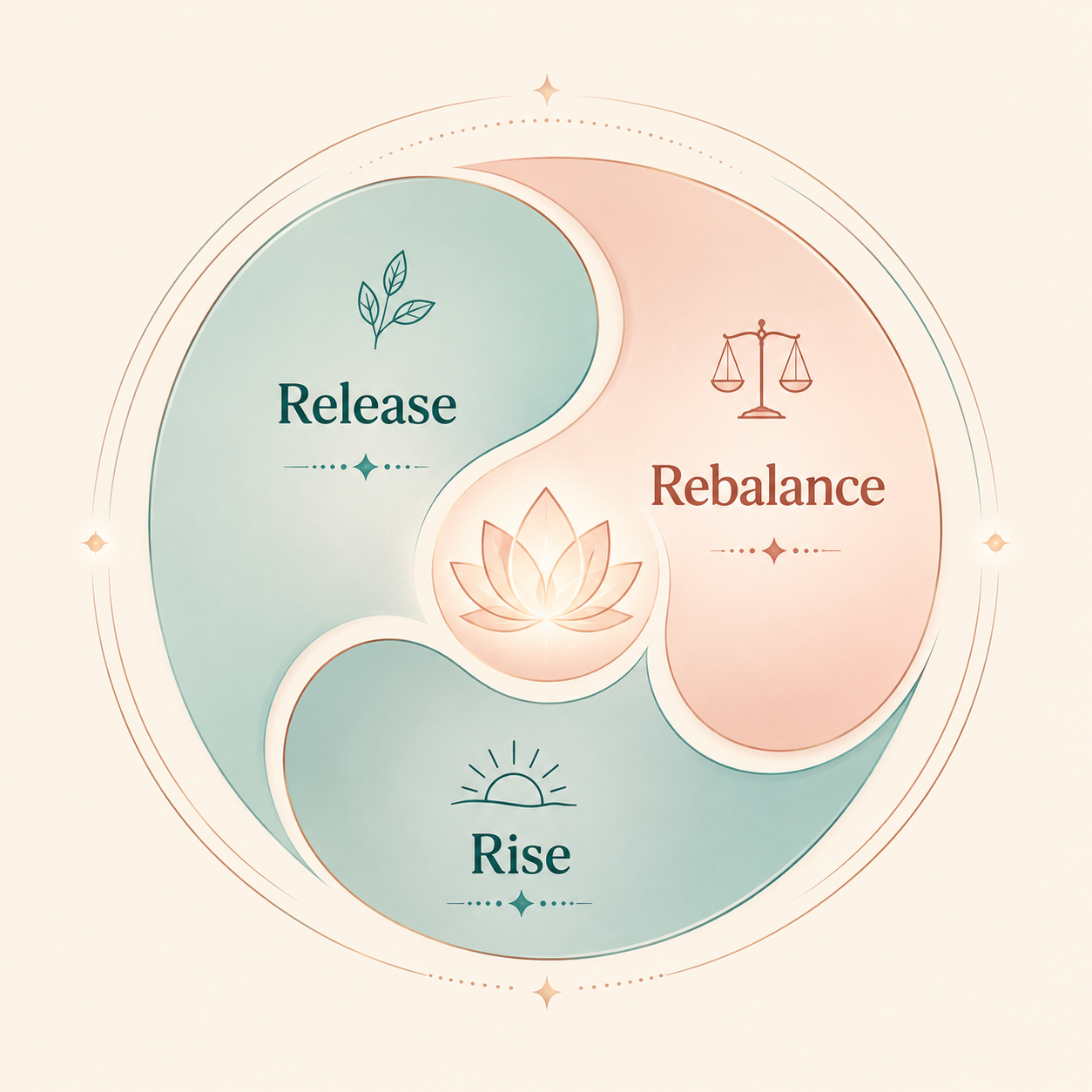
Release
Before you can think clearly about what this is, your body needs to stop bracing. Gentle EFT tapping and slow breathwork help release the stored tension your nervous system has been holding through months of uncertainty and self-doubt.
Rebalance
So much of this season is spent in harsh inner narrative — "what is wrong with me," "I should be coping better." Ho'oponopono and compassionate self-talk gently rebalance that story, so you can meet yourself with the same kindness you offer everyone else.
Rise
As the body settles and the inner voice softens, you begin to reconnect with yourself beyond the confusion — not the woman you were at 30, but the steadier, wiser woman emerging now.
A Simple Self-Check Before Your Next Doctor's Visit

Sit quietly with a notebook and answer these honestly. Bring your answers with you — they make the conversation far more useful.
- Have your periods changed in timing, flow or intensity?
- Do your moods shift along with your cycle, or do they feel constant regardless?
- Are you still able to function day to day?
- Do you feel irritable more than hopeless, or hopeless more than irritable?
- Has this built gradually, or did it arrive suddenly?
“Whatever this season turns out to be, your feelings are real, and they deserve care.”
A story I often think about
A woman in her late forties came to me convinced she was "just depressed." For nearly a year she had been waking heavy, snapping at her children, and quietly believing she had become a weaker version of herself. She had not connected any of it to her body.
When she finally sat with a doctor and described the full picture — including her changing cycle — she learned that hormonal shifts were a major driver of what she was feeling. Not the whole story, but a large part of it.
What changed everything was addressing both sides together: the medical support she needed, alongside gentle daily RRR practices for her nervous system and her inner narrative. "I stopped fighting myself," she told me. "That was the turning point." (Her story is shared with permission, with details changed to protect her privacy.)
Common mistakes women make here
- Guessing at the answer instead of asking a doctor
- Assuming it is "just aging" and never investigating
- Treating it as an either/or question when it can genuinely be both
- Waiting until symptoms become severe before reaching out for support
Frequently asked questions
How common is it for these two to overlap?
Very common. Because the hormones that shift during perimenopause influence the same brain chemistry involved in mood, symptoms frequently overlap and can be difficult to separate without support.
At what age does perimenopause usually start?
Most often in the mid to late 40s, but it can begin as early as the mid-30s. Age alone should never be used to rule it out.
Can perimenopause cause anxiety, not just low mood?
Yes. Many women experience new or heightened anxiety during this stage, sometimes before any other symptom becomes obvious.
How long does perimenopause usually last?
It varies widely — often several years, sometimes as long as a decade — before periods stop completely.
Can I have both perimenopause and depression at the same time?
Yes, and many women do. Perimenopause is recognized as a window of increased vulnerability to depression, so having both is not unusual and does not mean you are failing at anything.
Should I see a doctor or a therapist first?
If physical symptoms such as cycle changes, hot flashes or sleep disruption are present, starting with a doctor helps rule out hormonal and other medical causes. If low mood is persistent, heavy or affecting your safety, please reach out to a mental health professional without delay.
Do hot flashes on their own mean I'm depressed?
No. Hot flashes are a physical sign of hormonal change, not a sign of depression — though disrupted sleep from night sweats can certainly affect mood over time.
Do lifestyle changes actually make a difference here?
They do. Steady sleep, gentle movement, nervous system practices, and reducing caffeine and alcohol will not replace medical care, but they meaningfully support how you feel through this transition.
Your Next-Step Plan
- Day 1–2: Sit with the self-check questions above and write down your answers.
- Day 3: Book a doctor's appointment and take your notes with you.
- Day 4: Try one EFT tapping round: "Even though I don't know what this is yet, I choose to be gentle with myself."
- Day 5: Start tracking your mood alongside your cycle in a simple notebook.
- Day 6: Reduce caffeine and alcohol for the day and notice how your sleep responds.
- Day 7: Reflect on any pattern you noticed this week — timing, triggers, or moments of relief.
What you can do next
- Download the free guide 5 Things Every Woman Over 40 Should Know About Her Body to understand what your body is trying to tell you.
- If you'd like personalised support, book a free clarity call with me at meghalatha.com.
- Read the emotional wellbeing chapter of Your Body Is Speaking to understand what your body has been trying to say.
Healing doesn't happen because we know more. It happens because we gently practice what truly supports our body, in a consistent manner. You are much, much more powerful than what you think you are. Take care of yourself today.