
Waking Up at 3am in Perimenopause: Why It Happens (And the 10-Minute Way Back to Sleep)
By Meghalatha Gopal · Self-Healing Mentor & Author of Your Body Is Speaking

You are awake again.
Not groggy-awake. Properly awake — eyes open, mind switched on, as if someone had flicked a light on inside your head. And you already know, before you look, roughly what time it is.
You look anyway.
3:07.
Almost the same as last night. Almost the same as the night before that.
And then the second thing starts, which is worse than the waking: the arithmetic. If I fall asleep in the next ten minutes I'll still get three and a half hours. I have that meeting. I can't do another day like yesterday. Why is this happening to me.
You turn the pillow. You lie on the other side. You check the time again — 3:34 now, and somehow that feels like a personal failure.
If that is your night, most nights, I want to sit with you for a few minutes.
Because there is a reason it happens at that particular hour, it is not random, and it is not that you have "become a bad sleeper." And there is something you can do in the next ten minutes that works far better than lying there trying harder.
First — don't look at the clock again
Before you read another line, do this one thing.
If you're reading this in bed right now: turn your phone brightness all the way down, and when you put it away, put it face down and out of reach.
And put one hand on your belly.
Breathe out slowly — longer than you breathed in. Let the out-breath be lazy. Don't take a big dramatic breath in first.
Again. Keep it going while you read.
I'll explain in a moment why the out-breath matters more than anything else you could do at this hour. Your body doesn't need the explanation first, though. It just needs the breath.
You are not a bad sleeper. You are a woman in perimenopause.
Here is what women tell me, almost word for word.
"I fall asleep fine. It's the staying asleep."
"It's always between two and four. Always."
"I wake up hot, or I wake up with my heart going, and then I'm awake for two hours."
"I've started dreading bedtime, which is mad, because I'm exhausted."
"I've tried everything. Melatonin, no screens, lavender, that app. Nothing holds."
Can you relate to any of those?
This article is about waking in the night — if you struggle to fall asleep in the first place, that is a different mechanism and has its own guide.
Early-morning waking is one of the most common experiences of perimenopause, and one of the most demoralising — because it doesn't feel like a symptom. Hot flashes feel like a symptom. Waking at 3am just feels like you, failing at something every other adult manages without thinking.
It isn't you failing. One thing I've noticed after working with many women in midlife: by the time she tells me about her sleep, she has usually been quietly blaming herself for months. She has read the sleep hygiene lists. She has done the things. And when the things didn't work she concluded the problem must be her.
The problem is not her. The problem is that most sleep advice is written for people whose hormones are steady, and yours are not.
VIDEO — 3am wake-up guided practice (YouTube embed)
“Would you rather be talked through it? I've recorded the whole practice as a video, so you can follow along in the dark with your eyes closed instead of reading a screen at 3am.”
Why 3am, specifically? (There are five reasons, and they stack)
Let me explain this in plain language, because understanding it takes away about half the distress on its own.
1. Your cortisol starts climbing in the early hours — it always has
Cortisol is your main stress hormone, but it's also your get-up hormone. It begins rising in the small hours of the morning and peaks shortly after you wake. That has been happening every night of your life, since you were a child.
What has changed is what's cushioning it.
2. Progesterone was your sleep padding, and it goes first
Progesterone is your body's own calming chemistry. It's the softness between you and the world, and it supports deep, unbroken sleep. In perimenopause it often falls earlier and faster than oestrogen does.
So the same ordinary cortisol climb that used to pass completely unnoticed now has nothing to land on. It tips you over an edge instead of gliding under you.
Think of it like sleeping in a house next to a railway line. The trains have always run at 3am. You just used to have double glazing.
3. Blood sugar dips in the night — and a dip wakes you
If dinner was early, light, or mostly carbohydrate, your blood sugar can fall in the small hours. Your body treats a low as an emergency and releases adrenaline and cortisol to lift it.
That is a genuine, physical, wake-you-up event. It is one of the most common and most missed causes of 3am waking in midlife, and it's also one of the easiest to change.
4. A hot flush can wake you before you ever feel hot
Night flushes often surface you a minute or two before you consciously register the heat. You wake with your heart going, throw the blanket off, and never connect the two. Your body temperature has to drop slightly for sleep to hold — a flush works directly against that. And if it is night sweats waking you, calming the nervous system changes that pattern too.
5. And then the loop starts
This is the part almost nobody explains, and it matters more than the other four put together.
You wake. You notice you're awake. You become anxious about being awake — the arithmetic, the meeting, tomorrow. Anxiety releases adrenaline. Adrenaline is the exact chemistry your body uses to keep you alert in danger.
So the worry about not sleeping is now physically preventing you from sleeping — and it is exactly why eight hours still leaves you exhausted when the night breaks like this. It is also why the weight will not move when sleep is broken, even when your eating has not changed.
The pounding heart makes it worse again — and if that's a big part of your nights, please also read what's happening with perimenopause heart palpitations, because the two share the same alarm system.
Key takeaway: you don't wake at 3am because something is wrong with you. You wake because a normal hormonal rise now has no padding under it — and you stay awake because of what happens in your mind in the ninety seconds afterwards.
That second part is the part we can change tonight.
Please read this: when broken sleep needs a doctor
I want to be straight with you, because trust matters more to me than page views.
Everything here is for the ordinary hormonal broken sleep of perimenopause. Please do speak to your doctor if any of these fit you:
- Loud snoring, gasping, or your partner says you stop breathing. Sleep apnoea becomes much more common in women after 40 and is very often missed, because we're all looking at hormones instead.
- Restless, crawling legs at night that make you want to move them.
- Waking that comes with chest pain, breathlessness, or fainting.
- You feel low most of the day, most days, or you've lost interest in things you used to enjoy. Early waking is a recognised feature of depression, and it deserves proper care, not a breathing exercise.
- Exhaustion out of proportion to your sleep, which is worth a blood test — thyroid, and your ferritin, not just haemoglobin. Both are commonly off in midlife and both wreck sleep.
Getting checked is not a failure of self-healing. It's part of it. And there's a practical reason: once you know nothing serious is going on, every practice below works better — because a good part of what keeps you awake is the quiet worry that something is wrong.
I'm a self-healing coach, not a doctor. I'm here for the part your doctor doesn't have twenty minutes to teach you.
Five things you've probably been told that aren't quite true
Myth 1: "You need eight unbroken hours."
Eight is an average, not a rule, and human sleep has never been perfectly unbroken. Some waking in the night is normal at every age. What perimenopause changes is how easily you get back down. That's the thing to work on — not the number.
Myth 2: "If you can't sleep, get up and leave the room."
This is genuinely good advice for long-term insomnia. It is often the wrong advice at 3am in perimenopause, because getting up, turning on lights and walking about raises your cortisol further and firmly tells your body the night is over. Try settling where you are first. Get up only if you've been awake and agitated for a long stretch.
Myth 3: "It's just stress. Relax more."
Being told to relax while lying rigid at 3am is not useful, and you know it. This isn't a willpower problem. It's a chemistry problem with a practice attached.
Myth 4: "A glass of wine helps you sleep."
It genuinely helps you fall asleep, and then it wakes you a few hours later as your body processes it — often at exactly this hour, often with your heart going. You don't have to give it up. Just watch the pattern for two weeks and let your own evidence decide.
Myth 5: "There must be one supplement that fixes this."
Magnesium, and steady evening blood sugar, and a cool dark room all genuinely help — and I'll cover them. But no capsule will teach your nervous system that the night is safe. Only repetition does that. Consistency beats intensity, every single time.
The Calm Night Framework
Everything I teach around sleep sits in three layers. You need all three eventually. You only start with one.
Layer 1 — In the moment. What you do in the ninety seconds after you wake, so you don't hand the night over to adrenaline. That's The Way Back, below.
Layer 2 — In the evening. Lowering the baseline so the 3am rise has something soft to land on. Ten minutes before bed.
Layer 3 — In the day. Removing the fuel: morning light, caffeine timing, blood sugar, and the unspent stress you carry into the pillow.
Most women want Layer 1 first, and that's exactly right. But please notice: Layer 1 gets you through tonight. Layer 2 is what makes the wakings shorter, and then rarer.
The Way Back: ten minutes to get back to sleep
Four steps. Still. Cool. Breathe. Unload.
All of it can be done lying down, in the dark, without waking the person beside you, and without getting out of bed.
Step 1 — Still (the first 90 seconds)

Do not look at the clock. Not once.
This is the single highest-value instruction on this page. Every time you check the time you do arithmetic, and arithmetic releases adrenaline. Turn the clock to the wall before bed. Put the phone face down, across the room if you can.
Then say to yourself, plainly:
“I'm awake. That's allowed. Even resting here is doing something for me.”
Why it works: your body cannot begin the descent back into sleep while it is being asked to solve a problem. Removing the clock removes the problem. What you are doing here is taking the fight out of the night.
Step 2 — Cool (30 seconds)

Slide one foot — or both — out from under the blanket.
If you woke hot, push the covers off your chest for a minute. Take one small sip of water if your mouth is dry, but don't drain the glass.
Why it works: your body temperature has to fall slightly for sleep to take hold. Your hands and feet are where you release heat fastest. This is a very small thing that works surprisingly quickly, and it's the specific antidote to a flush-related waking.
Step 3 — Breathe (4 minutes)
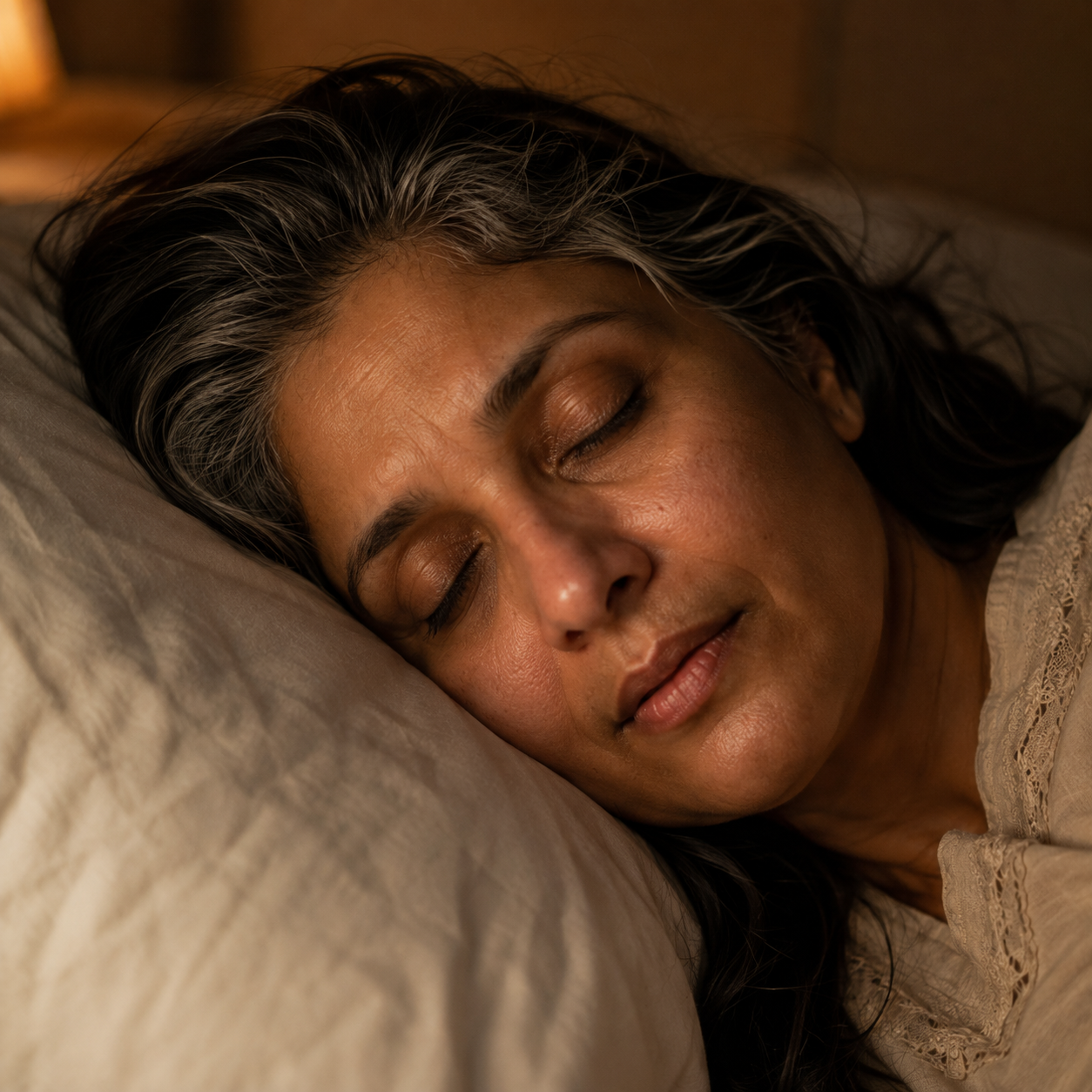
Now the out-breath.
Breathe in through your nose for a count of four. Breathe out, slowly and softly, for a count of eight.
If eight is a strain tonight, use six. Never force it — straining is just another stress, and your body can't tell the difference.
Do ten of these. Then stop counting and let your breathing do whatever it likes.
Add one thing if you're awake enough to bother: on the out-breath, let your jaw come apart, so your back teeth aren't touching. Most women hold the whole night in their jaw without ever knowing it.
Why it works: a long out-breath activates the vagus nerve, which carries the slow-down message from your brain stem down past your heart. It is not a belief system — it's wiring you were born with, and it's the fastest lever you have at 3am.
Step 4 — Unload (the rest)

If a thought keeps coming back — the meeting, the money, your mother, that email — it isn't going to leave because you told it to.
So do this instead. Say it once, silently, and give it a home:
“That's for tomorrow. It's written down. I'll do it at ten.”
If it truly won't go, keep a small notebook and pencil beside the bed — not your phone — and write one line in the dark. You don't need to read it back. The point isn't the note. The point is that your brain will stop rehearsing something once it believes it's safely stored.
Then let your attention go to the heaviest part of your body. Usually your legs. Notice the weight of them. Notice the weight of your hips in the mattress. Let each out-breath make them a little heavier.
If your mind wanders — it will — that's not failure. That's the drift. That's the thing we're actually after.
What can you do today? Practise all four steps once tonight before you need them, while you're calm and falling asleep normally. You are teaching your nervous system the road down while it's daylight, so it can find it in the dark.
Your daily practices — making the wakings rarer
The Way Back gets you through tonight. These make the nights come less often.
Morning (5 minutes)
- Daylight at a window within an hour of waking. Two minutes is enough; ten is better. This is the single most underrated sleep practice there is — morning light sets the clock that decides when your cortisol rises tomorrow night.
- Before your phone: hand on chest, six long out-breaths.
- A glass of water before your tea or coffee.
During the day
- Last caffeine before midday. Just for one week, as an experiment. Caffeine lingers far longer than we assume — the four o'clock tea is still working at midnight.
- Protein at every meal, and please don't skip lunch. Steady blood sugar in the day is what prevents the crash at night.
- Move your body, earlier rather than later. A walk counts. Hard exercise late in the evening keeps some women wired for hours.
- One "sigh break" at 3pm. Two breaths in, one long out, three times. Twenty seconds. It stops the day stacking up until bedtime.
Evening (10 minutes) — this is the one that changes things
- Eat enough at dinner, two to three hours before bed. If you wake hungry, or wake at exactly the same time nightly, try a small protein-containing snack before bed — a few nuts, some curd, a spoon of nut butter. Many women see a change within a week from this alone.
- Be honest about alcohol. Two weeks of noticing, no decisions.
- Cool the room, and cool it early. Cooler than feels cosy when you get in.
- Write tomorrow's three things on paper. An unfinished list is a low-grade alarm running all night.
- Ten minutes of Still and Breathe before bed — while you're calm. Steps 1 and 3, done deliberately, every night, whether you need them or not.
Key takeaway: the evening ten minutes is worth more than anything else on this page. Not because it's powerful in the moment, but because it's the one your body actually learns from.
"I was so tired I cried at a traffic signal"
Let me tell you about a woman I'll call Sudha. She's forty-nine, she runs a small business with her husband, and the details here are changed — but the shape of it is one I meet constantly.
She had been waking between 3 and 3:30 for nearly a year. Never trouble falling asleep. Always awake in the small hours, always for at least ninety minutes, and by then she had stopped even calling it a problem. It was just her life.
What broke her wasn't the tiredness. It was crying at a traffic signal on an ordinary Tuesday, for no reason she could name, and being frightened by that.
What we changed was not dramatic.
She moved her coffee to the morning only. She started eating a proper dinner instead of "something light" at nine o'clock, and put a few soaked almonds by the bed. She turned the clock to face the wall — she resisted this one, and it turned out to be the biggest lever of all. And she did ten minutes of breathing before bed every night, calm or not.
Week one: nothing. She told me it wasn't working.
Week two: she still woke at 3am, but she was back asleep in about twenty minutes instead of ninety.
Week six: she woke perhaps three nights out of seven, and on the nights she woke, she didn't mind. That was the sentence she used — I don't mind it any more.
And that is almost always the order it happens in. Not: the waking stops, so I stop dreading it. It's: I stop dreading it, and then the waking loosens.
Seven mistakes that keep you awake
- Checking the clock. Every check is an arithmetic problem, and arithmetic wakes you. Turn it around tonight. This one is free and it works.
- Picking up the phone. Light, information and other people's lives, all at once, at the exact moment your brain is deciding whether the night is over. Nothing you read at 3am is read calmly.
- Trying hard to sleep. Effort is arousal. Aim for rest, not sleep — resting quietly is genuinely restorative, and paradoxically it's what lets sleep return.
- Going to bed earlier to "catch up." More time in bed awake teaches your body that bed is where you lie awake. Keep your wake-up time steady instead, even after a bad night.
- A light dinner, late. The most common hidden cause I see. You're not eating too much in the evening. Many women are eating too little, too early.
- Changing eight things at once. Caffeine, alcohol, screens, magnesium, temperature, exercise, journalling — all on Monday, all abandoned by Thursday. Change one. Let it become normal. Then the next.
- Judging it after four days. A nervous system learns by repetition, not intensity. Give any practice two full weeks before you decide.
Frequently asked questions
Why do I wake up at exactly 3am every night in perimenopause?
Because your cortisol naturally begins to rise in the early hours, and in perimenopause you have less progesterone cushioning that rise. The clock-like regularity feels eerie, but it simply reflects how regular your own hormonal rhythm is. Blood sugar dips and night flushes tend to arrive in the same window, which is why so many women land on the same time.
Is waking up at 3am a sign of perimenopause?
It's a very common one, especially alongside night sweats, heavier or irregular periods, anxiety or a pounding heart. It isn't proof on its own — thyroid problems, low iron, sleep apnoea and depression all cause early waking too, which is why one round of checks is worth it.
Why do I wake up with my heart pounding?
Usually a surge of adrenaline or cortisol, sometimes triggered by a blood sugar dip or a flush. It's frightening, and it's very common in midlife. I've written about it in detail in the article on perimenopause heart palpitations, including a four-minute practice for the moment it happens.
Should I get up if I can't sleep?
Try settling where you are for the first twenty to thirty minutes, using The Way Back. If you're still wide awake and agitated after that, get up, keep the lights very low, do something dull — no phone, no screens — and go back when you feel sleepy. What you're avoiding is lying in bed fighting.
Does melatonin help with perimenopause 3am waking?
Melatonin mostly helps people who struggle to fall asleep or whose body clock is shifted. Early-morning waking is usually a different mechanism, so many women find it disappointing. It's also regulated differently in different countries — please check with your doctor or pharmacist rather than ordering online.
Will HRT fix my sleep?
For some women it makes a real difference, because it addresses the hormonal swings underneath, and treating night flushes alone can transform sleep. It isn't right for everyone and it depends on your history. That's a conversation for your doctor, and a good one to have. Nothing here asks you to choose between medical support and self-healing — they work well together.
Does magnesium help?
Many women find it helps with sleep quality and muscle tension, and magnesium is involved in normal nerve function. It is not a treatment for insomnia, and it interacts with some medicines and kidney conditions, so please check before starting.
Is it my blood sugar?
Test it kindly, not clinically: for one week, eat a fuller dinner and have a small protein snack before bed. If the waking softens within seven to ten nights, you have your answer. It's one of the fastest wins available in midlife.
I wake up hot. Is that the same thing?
Often, yes — a night flush can surface you a minute before you feel the heat. Treat them as one event. Cool the room early, sleep in layers you can push off without getting up, and use the same long out-breath.
How long does this phase last?
It varies, and I won't pretend otherwise. It tends to come and go over months, clustering around the times your hormones swing most. What changes fastest — usually within two or three weeks — is not whether you wake, but how long you stay awake and how much it costs you the next day.
I'm exhausted. Can I nap?
A short nap, twenty minutes, before 3pm, is fine and can be genuinely restoring. Long or late naps borrow from tonight. And please don't go to bed at nine to compensate — hold your usual times, especially your wake-up time.
Nothing has worked for me. Why would this?
Because most of what you've tried was aimed at falling asleep, and your problem is staying asleep — a different mechanism entirely. And because the piece almost nobody teaches is what to do in the ninety seconds after you wake. That window is where the night is won or lost.
THE WAY BACK — 4-step summary card (Canva, 1000×1250)
Your 7-day calm night plan
Small. Doable. Please don't add anything to it.
| Day | The one thing |
|---|---|
| Day 1 | Turn the clock to the wall. Phone face down and out of reach. |
| Day 2 | Two minutes of daylight at a window within an hour of waking. |
| Day 3 | Move your last caffeine to before midday. |
| Day 4 | Eat a fuller dinner, and put a small protein snack by the bed. |
| Day 5 | Add the 10-minute evening practice — Still and Breathe — before bed. |
| Day 6 | Notebook and pencil beside the bed. Write tomorrow's three things. |
| Day 7 | Look back. Write down one thing that is even slightly different. |
Then repeat the week. That's the whole method: repeat, don't escalate.
Today's action steps
- ☐Turn your clock to face the wall — do it now, before you forget
- ☐Decide your caffeine cut-off time and say it out loud
- ☐Put a notebook and pencil beside the bed, and move the phone charger across the room
- ☐Plan tonight's dinner so it's a real one
- ☐Practise the four steps once tonight while you're calm
Three questions to sit with
- When I wake at 3am, what is the first sentence I say to myself? Is it a kind one?
- What am I carrying into the pillow every night that I haven't put down?
- If I stopped counting the hours, what would actually be different tomorrow?
If you'd rather not work this out alone
VIDEO — guided version, second placement (YouTube embed)
If you've read this far, I suspect you've been running on four and a half hours for a long time, and telling everybody you're fine.
You don't have to keep doing that on your own.
Start here — my free guide, 5 Things Every Woman Over 40 Should Know About Her Body. It explains what your body is really asking for, with simple daily practices that calm your nervous system — save it to your phone so you can come back to it.
Watch the guided version. The 3am wake-up video walks you through the whole practice, so you can follow along in the dark with your eyes closed.
And if you'd like support built around you — your hormones, your history, your particular 3am — that's what my 1:1 Midlife Reset work is for. We start with a conversation, not a commitment. If I'm not the right person to help, I'll say so and point you somewhere better.
AUTHOR PHOTO — meghalatha-gopal-midlife-self-healing-coach.jpg (800×1000)
A message from me to you
I want to leave you with the thing I most want you to hear.
Lying awake in the dark makes everything feel permanent. At 3am, a hard week feels like a hard life, and a bad night feels like proof that your body has stopped working properly.
Your body has not stopped working. It is doing exactly what it was built to do — rousing you for the day — with less of the steadying hormones it used to have to soften the edges. It isn't broken. It's unpadded. And an unpadded body doesn't need to be fought or fixed. It needs to be reassured, patiently, again and again, until it believes you.
So tonight, before you sleep, turn the clock to the wall and take ten long out-breaths. That's all I'm asking of you today.
Healing doesn't happen because we know more. Healing happens because we gently practise what truly supports our body, one day at a time.
I'm glad you're here. Be gentle with yourself tonight.
— Meghalatha
This article is for education and support. It is not medical advice and it does not replace assessment, diagnosis or treatment by a qualified healthcare professional. Please never stop or change prescribed medication without speaking to your doctor.