Perimenopause Heart Palpitations: Why Your Heart Races at 2am (And a 4-Minute Reset That Calms It)
By Meghalatha Gopal · Self-Healing Mentor & Author of Your Body Is Speaking
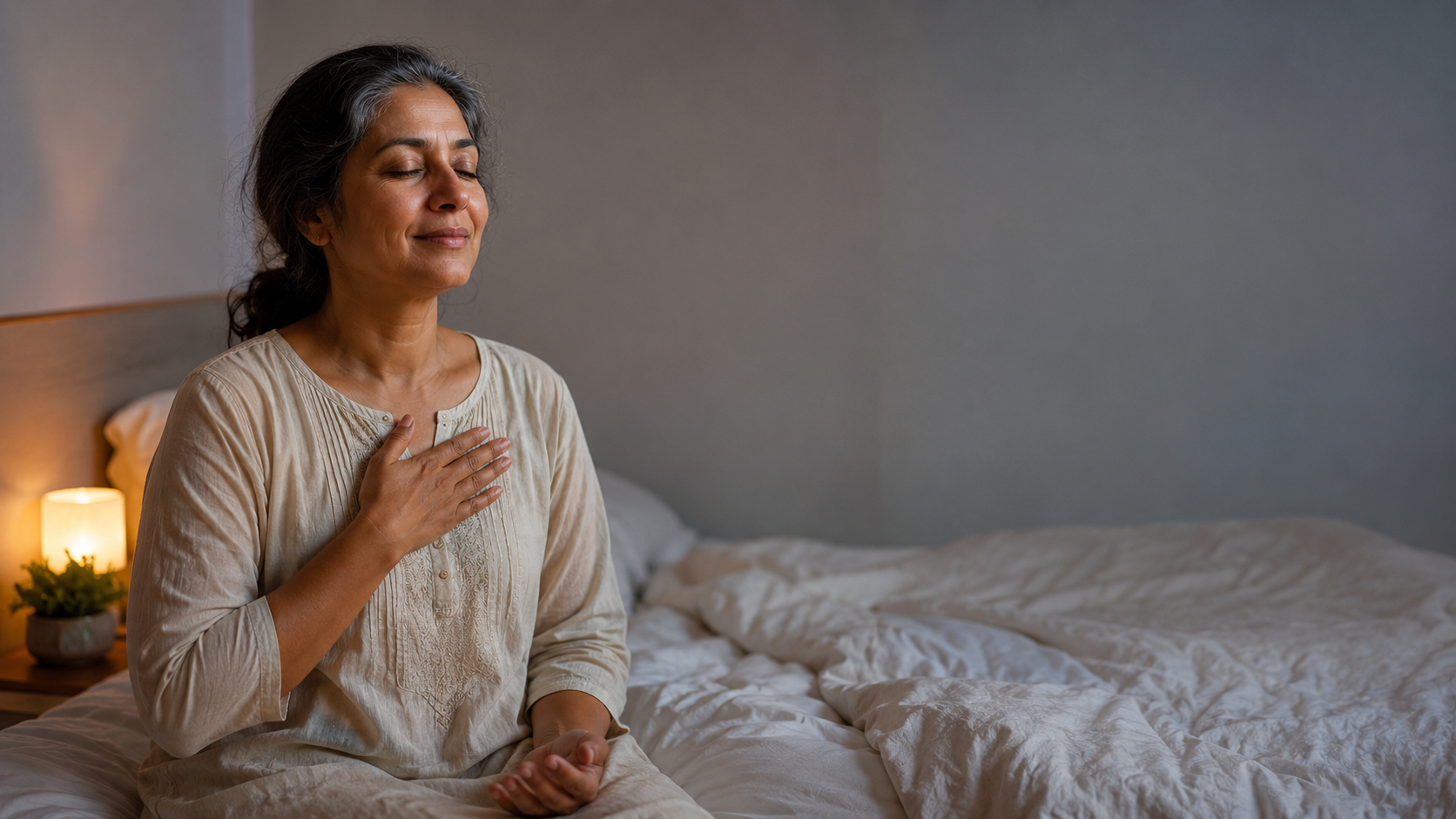
It's 2:14 in the morning.
You didn't wake up slowly. You surfaced — the way you do when someone calls your name in an empty house. And your heart is going. Not fast exactly. Hard. You can feel it in your throat and in your ears, and the sheet over your chest seems to be moving with it.
You lie very still. You put two fingers on your wrist. You think about waking your husband and then decide not to, because what would you even say.
And underneath it all sits the thought you've been having for weeks now, the one you haven't said out loud to anybody:
Something is wrong with me.
If that is where you are tonight — or where you've been at 2am for the last three months — I want to sit with you for a few minutes. And if waking at 3am with your heart pounding has become a pattern, there is a way back to sleep for that too.
Because there is an explanation. It is not the one you're afraid of. And there is something you can do about it in the next four minutes, lying exactly where you are.
First, breathe out with me
Before you read another line.
Put one hand flat on the centre of your chest.
Now breathe out — slowly, for longer than you breathed in. All the way to the end of the breath.
Again. In through your nose, and a long, slow out.
Keep that going while you read. I'll explain why it works in a moment, but your body doesn't need the explanation first. It just needs the out-breath.
You are not imagining this, and you are not alone
Here is what women tell me, almost word for word, over and over.
"It only happens at night."
"It happens when I'm sitting perfectly still — that's the part that scares me."
"I had an ECG. They said it was fine. So why is it still happening?"
"I've started sleeping badly on purpose because I'm afraid of waking up like that."
"I feel like a hypochondriac. But I also feel like something is genuinely wrong."
Can you relate to any of those?
Heart palpitations are one of the most common experiences of perimenopause — and one of the least talked about. Hot flashes get discussed. Mood swings get discussed. But a heart that pounds for no reason at 3am gets kept quiet, because it feels too serious to mention casually and too vague to make a fuss about.
So women carry it alone. And carrying it alone is precisely what makes it worse — for reasons that are physical, not imaginary, and which I'll show you in a moment.
One thing I've noticed after working with many women in midlife: by the time she tells me about the palpitations, she has usually been frightened for months. And a large part of what her body is reacting to, by then, is the fear of the next episode.
That part we can work with tonight.
“Prefer to be guided through it? I've recorded the whole practice as a video — the explanation is in the first three minutes and the 4-minute reset starts at 3:40. You can do it lying in bed with your eyes closed.”
What is actually happening in your body
Let me explain this in plain language, because understanding it takes away about half the fear on its own.
Think of your nervous system as the smoke alarm in your house. When it's working properly, it goes off for fire. Nothing else. It ignores the kettle, the shower, the toaster.
In perimenopause, two things change — and both of them make that alarm more sensitive.
1. Oestrogen is falling, and oestrogen was steadying you
Oestrogen does far more than manage your periods. It helps keep your blood vessels relaxed and flexible, and it softens how strongly your body reacts to adrenaline.
As oestrogen falls — and in perimenopause it doesn't fall smoothly, it swings up and crashes down, sometimes within the same week — that softening goes. Now the same small amount of adrenaline produces a much bigger reaction than it did at thirty-five.
Your smoke alarm hasn't broken. It has become so sensitive that it goes off when you make toast.
2. Progesterone is falling too, usually first
Progesterone is your body's own calming chemistry. It's the padding between you and the world. In perimenopause it often drops earlier and faster than oestrogen does.
Less padding means a small stress now lands like a big one. A thought about your daughter. A slight dip in blood sugar. A noise outside. A message you half-read before bed.
3. And then the loop starts
Here's the part almost nobody explains, and it matters more than anything else on this page.
Adrenaline goes up. Your heart beats harder. You notice your heart beating harder, and you become frightened. Your brain — which is only doing its job — concludes that if your heart is pounding this hard, something must genuinely be wrong, and it releases more adrenaline to deal with the danger.
The pounding frightens you. The fright makes it pound harder.
That's the loop. And this is very good news, though it may not feel like it yet — because a loop has a place where you can step in. You don't have to make your heart stop. You only have to stop feeding the fear at one point in the circle, and the whole thing loses power.
Key takeaway: your heart is not misbehaving. Your alarm system has lost its cushioning, and your own fear is keeping the alarm ringing after the toast has been eaten.
Why 2am and 3am specifically?
Because your cortisol — your main stress hormone — naturally begins to rise in the early hours of the morning. That is completely normal. It's the mechanism that gets you ready to wake up. It has been happening every night of your life.
What's changed is that you're now going into that rise with less padding.
So a hormonal climb that used to pass completely unnoticed now tips you over an edge, and you wake with your heart thumping and no explanation for it. Nothing is chasing you. There's no bad news. Your body has set off an alarm in an empty house.
Many women also notice the pounding arrives with a hot flush, or a minute or two before one. That's real: your heart rate genuinely does rise during a flush. If you wake up hot and pounding, those two things are connected — and they respond to the same practice.
Please read this part: when palpitations do need a doctor
I want to be straight with you, because trust matters more to me than page views.
Everything in this article is for the palpitations that a doctor has already looked at and told you are hormonal, or stress-related, or "nothing to worry about."
Please see a doctor — and don't put it off — if your palpitations come with any of these:
- Chest pain or pressure
- Breathlessness that isn't normal for you
- Dizziness, feeling you might faint, or actually fainting
- Palpitations that start when you're exerting yourself, rather than when you're resting
- Episodes that go on for a long time, or a pulse that feels wildly irregular
- A family history of heart problems or sudden cardiac events
And there are two very ordinary things worth ruling out in midlife, because they are missed all the time:
- An overactive thyroid. It makes your heart race and it becomes more common in your forties.
- Low iron. Very common in perimenopause, when periods often become heavier. Low iron makes your heart work harder and beat faster.
Both show up on a simple blood test. Ask for both. Ask for your ferritin, not just your haemoglobin.
Getting checked is not a failure of self-healing. It is part of it. And here's the practical reason: once you know your heart is healthy, every practice below works better — because half of what keeps the alarm ringing is the unspoken fear that something is seriously wrong.
I'm a self-healing coach, not a doctor. I'm not here to replace your medical care. I'm here for the part your doctor doesn't have twenty minutes to teach you.
Five things you may have been told that aren't quite true
Myth 1: "If your ECG was normal, it's all in your head."
A normal ECG tells you your heart's structure and rhythm are fine at the moment it was recorded. That's genuinely reassuring. It doesn't mean nothing is happening. Your nervous system is real, adrenaline is real, and a body running on a sensitised alarm is a physical event, not an imagined one.
Myth 2: "It's just anxiety."
It's often called anxiety and treated as anxiety, when in perimenopause the sequence frequently runs the other way round. The body fires first — hormone dips, adrenaline, pounding heart — and the anxious thoughts arrive afterwards to explain the sensation. Many women describe it exactly like that: "I feel the panic in my body before I have anything to panic about." If the anxiety that arrives for no reason at all has been with you for a while, it is worth understanding what else it can be.
Myth 3: "You have to wait it out until menopause is over."
You may not be able to control the hormonal swings. You can absolutely influence how loudly your nervous system responds to them. That's the whole point of the work below.
Myth 4: "Deep breathing means big deep breaths."
Big gulping inhales can make palpitations worse. What calms your heart is the out-breath — long, slow, unhurried. Length, not size.
Myth 5: "There must be one supplement that fixes this."
Magnesium, hydration and steady blood sugar all genuinely help, and I'll cover them. But no capsule will teach your nervous system that it's safe. Only repetition does that. Consistency is more powerful than intensity — every single time.
The Calm Heart Framework
Everything I teach around palpitations sits in three layers. You need all three, but you only start with one.
Layer 1 — In the moment. The rescue. What you do while it's happening, at 2am, in the dark. This is the 4-Minute Reset below.
Layer 2 — In the evening. Lowering the baseline, so the alarm has less to react to in the night. Ten minutes before bed.
Layer 3 — In the day. Removing the fuel — caffeine timing, blood sugar, water, and the unspent stress you carry from the day into the pillow.
Most women want to start with Layer 1, and that's exactly right. But please notice: Layer 1 is what gets you through tonight. Layer 2 is what makes the nights come less often.
The 4-Minute Reset for perimenopause heart palpitations
Four steps. One minute each. Hand. Breath. Tap. Words.
You can do all of it lying down, in the dark, without getting out of bed, and the person beside you will not know you're doing anything at all.
Step 1 — Hand (1 minute)
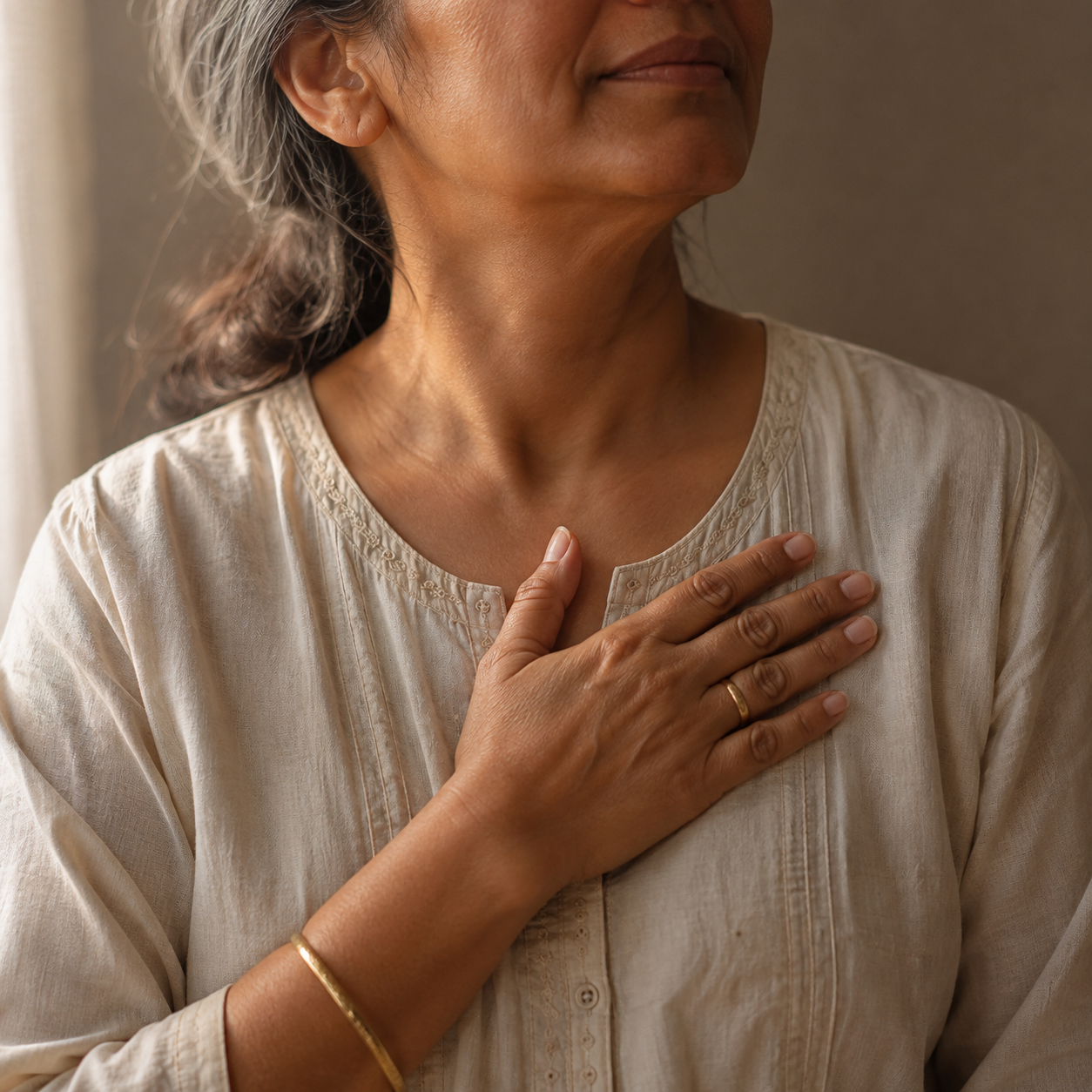
Put one hand flat on the centre of your chest, and the other on your belly.
Feel the weight of your own hand. That is not a small thing. Warm, firm pressure on the chest is one of the fastest ways to signal to your body that it is not alone — it's the same reason a hand between the shoulder blades calms a crying child.
Press your heels into the mattress. Let yourself be heavy.
Why it works: your body needs to feel held before it will stand down. Don't rush this minute.
Step 2 — Breath (1 minute)
Breathe in through your nose for a count of four.
Breathe out through your mouth, slowly, for a count of eight.
Do six of these.
If eight is too long tonight, use six. Never strain — straining is just another stress, and your body can't tell the difference.
Then add one small thing: hum softly on the out-breath. A low mmmmm.
Why it works: a long out-breath activates the vagus nerve, which runs from your brain stem down past your heart. When you extend the exhale, that nerve sends a slow-down message to your heart. It's not a belief system — it's wiring you were born with. Humming stimulates the same nerve from the other end, through the vibration in your throat.

Step 3 — Tap (1 minute)
Keep breathing while you do this.
Using two fingers, tap gently — about the speed of a slow heartbeat — on each of these three places for about fifteen seconds:
- Just under your collarbone, on the flat bone
- Under your eye, on the cheekbone
- The soft fleshy side of your hand
While you tap, say quietly, out loud or in your head:
“Even though my heart is racing, I am safe right now. My body is trying to protect me. Nothing is wrong.”
Why it works: light rhythmic touch paired with a truthful sentence gives your brain a second stream of information that isn't panic. It gives the alarm somewhere else to go. Notice whether it's even ten per cent quieter than a minute ago. Ten per cent is the direction, and the direction is what matters.

Step 4 — Words (1 minute)
Keep your hand on your chest, and speak to your own body. Not to the universe. To your body — the one that has been working for you without a single break for forty-something years.
Slowly:
“I'm sorry. Please forgive me. Thank you. I love you.”
Then open your eyes and name five things you can see in the room. The wardrobe. The curtain. The line of light under the door.
Why it works: for weeks you have been fighting your own heart — willing it to stop, frightened of it. Fighting is more stress, and more stress is more adrenaline. The moment you stop fighting your body and start thanking it, the alarm has nothing left to defend. And naming five things tells the oldest part of your brain: I know exactly where I am. There is nothing here.

What can you do today? Do these four steps once tonight while your heart is calm — before you ever need them. You're teaching your nervous system the way down while the road is clear, so it can find it in the dark.
Your daily practices — lowering the baseline
The reset gets you through the night. These make the nights come less often.
Morning (5 minutes)
- Before your phone: hand on chest, six long out-breaths. It sets the tone of your whole nervous system for the day.
- A glass of water before your tea or coffee.
- Two minutes of daylight at a window. It steadies the cortisol rhythm that later wakes you at 3am.
During the day
- Last caffeine before midday. Just for one week, as an experiment. Caffeine lingers far longer than most of us assume — the four o'clock tea is still in your system at midnight.
- Eat something with protein at every meal. Blood sugar that crashes in the night is one of the most common and most missed triggers of 3am waking with a pounding heart.
- Water. Mild dehydration alone raises your heart rate.
- One "sigh break" at 3pm. Two breaths in, one long out, three times. Twenty seconds. It stops the day's stress from stacking up until bedtime.
Evening (10 minutes) — this is the one that changes things
- Finish eating around two to three hours before bed, with a small protein-containing snack if you tend to wake hungry — a few nuts, some curd.
- Be honest about alcohol. Wine helps you fall asleep and then wakes you at 3am with your heart going, because of what happens as the body processes it. You don't have to give it up. Just notice the pattern for two weeks and let your own data tell you.
- Ten minutes before bed: Hand and Breath. Steps 1 and 2. While you are calm.
- Write down tomorrow's three things on paper. An unfinished list is a low-grade alarm running all night.
- Keep the room cool and dark.
Key takeaway: the evening ten minutes is worth more than anything else here. Not because it's powerful in the moment, but because it's the one your body learns from.
"I thought I was going to die in my kitchen"
Let me tell you about a woman I'll call Radhika. She's forty-seven, she teaches, and the details here are changed — but the shape of it is one I see constantly.
Her palpitations started in the evenings, and then moved into the night. By the time we spoke she had been to the emergency department twice. Both times: ECG normal, bloods normal, sent home kindly with the word "anxiety."
Which made her feel worse, not better. Because she wasn't an anxious person. She'd raised two children and buried a parent and never once felt like this.
What we changed was not dramatic.
She moved her last coffee from 4pm to 11am. She started eating a proper lunch instead of teaching through it. And she did ten minutes of hand-and-breath every night before bed — not when the palpitations came, but every night, calm or not.
Week one: no change at all. She told me she thought it wasn't working.
Week two: she woke twice instead of five times, and the episodes were shorter.
Week five, and this is the part that mattered to her most: she woke with her heart pounding, put her hand on her chest, breathed out six times — and went back to sleep. No panic. No lying rigid for an hour. No looking up symptoms on her phone at 3am.
"It's not that it stopped. It's that it stopped being frightening. And then it mostly stopped."
That's the order it usually happens in. Not fear, then relief. First the fear loosens. Then the body follows.
Seven mistakes that keep the palpitations going
- Checking your pulse constantly. Every check is a question to your brain: are we in danger? And every question keeps the alarm system switched on. Put the fingers on your chest instead of your wrist.
- Looking up your symptoms at 2am. You will find the worst possible page, and adrenaline will do the rest. Nothing you read at 2am will be read calmly.
- Taking big deep breaths. Big inhales can make it worse. Long, slow out-breaths are the medicine.
- Only practising when it's happening. This is the biggest one. Practising only in an emergency is like trying to learn a phone number during a fire.
- Changing eight things at once. Caffeine, alcohol, sugar, sleep, exercise, supplements, screens — all on Monday. By Thursday it's abandoned. Change one thing. Let it become normal. Then change the next.
- Deciding it isn't working after four days. A nervous system learns by repetition, not by intensity. Give any practice two full weeks before you judge it.
- Not getting the simple things checked. Thyroid and iron. Please. It takes one blood test and it removes a huge amount of background fear.
Frequently asked questions
Are heart palpitations a normal part of perimenopause?
They're very common, and they're a recognised part of the hormonal changes of perimenopause — but "common" never means "don't get it checked." Have them assessed once, so that you know what you're working with. After that, the practices matter more than the worrying.
Why do my palpitations only happen at night?
Two reasons. Cortisol naturally rises in the early hours, and with less hormonal padding that rise can tip you awake. And at night there's nothing else competing for your attention — no work, no family, no noise — so your heartbeat is the loudest thing in the room.
Can perimenopause palpitations happen when I'm completely relaxed?
Yes, and this frightens women more than anything else, because it seems to prove there's no emotional cause. There often isn't one. The trigger can be purely hormonal. Sitting still doesn't mean your nervous system is still.
How long do perimenopause heart palpitations last?
Individual episodes usually last seconds to a few minutes. As a phase, they tend to come and go over months, often clustering around the times your hormones swing most. What changes fastest — usually within weeks — is not whether they happen, but how frightening they are and how quickly they settle.
Is it palpitations or a panic attack?
They overlap a great deal and can be hard to tell apart. In perimenopause, the body frequently fires first and the panicky thoughts arrive afterwards to explain the sensation. Either way, the calming practice is the same. If panic attacks are frequent or disabling, please talk to a professional as well.
Does magnesium help with menopause palpitations?
Many women find it helps with sleep and muscle tension, and magnesium is involved in normal heart and nerve function. It is not a treatment for palpitations, and it interacts with some medicines and kidney conditions, so please check with your doctor or pharmacist before starting it.
Should I stop drinking coffee completely?
Not necessarily. Try moving it earlier first — nothing after midday for one week. Most women find timing matters far more than quantity. Then decide with your own evidence rather than someone else's rule.
Does HRT help with palpitations?
For some women it does, because it addresses the hormonal swings underneath. It isn't right for everyone and it depends on your history. That's a conversation for your doctor, and it's a good one to have. Nothing on this page asks you to choose between medical support and self-healing — they work well together.
Can dehydration really cause my heart to race?
Yes. Even mild dehydration makes your heart work harder. It's one of the simplest things to correct and one of the most often overlooked.
Why does it come with a hot flash?
Your heart rate genuinely rises during a flush. If yours arrive together, treat them as one event, and use the same long out-breath — it helps both.
How soon will the 4-Minute Reset work?
Sometimes the first night. More often you'll notice a small softening at first — the episode ends sooner, or you're less frightened during it. That "less frightened" step is not a small win. It's the one that breaks the loop.
Does tapping actually do anything, or is it just distraction?
Distraction is part of it, and that isn't a criticism — giving a panicking brain a different stream of input is genuinely useful. Alongside that, slow rhythmic touch and a longer out-breath both support the body's calming response. What I can tell you honestly is that women use it, at 2am, when they're frightened, and they tell me it helps.
I've had all the tests and they're normal. So why do I still feel like something's wrong?
Because the feeling isn't produced by your heart. It's produced by an alarm system that hasn't yet learned it's safe. Test results reassure your mind. Only repeated practice reassures your body — and your body is the one setting off the alarm.
Your 7-day calm heart plan
Small. Doable. Please don't add anything to it.
| Day | The one thing |
|---|---|
| Day 1 | Learn the 4-Minute Reset while you are calm. Once, sitting down. |
| Day 2 | Move your last caffeine to before midday. |
| Day 3 | Add the 10-minute evening practice (Hand + Breath) before bed. |
| Day 4 | Protein at every meal, and a small snack before bed if you wake hungry. |
| Day 5 | Book the blood test — thyroid and ferritin. Then let that worry go. |
| Day 6 | Notice your alcohol pattern. Just notice. No decisions. |
| Day 7 | Look back. Write down one thing that is even slightly different. |
Then repeat the week. That's the whole method: repeat, don't escalate.
Today's action steps
- ☐Hand on chest, six long out-breaths — right now, before you close this page
- ☐Decide your caffeine cut-off time and say it out loud
- ☐Put a glass of water by your bed
- ☐Set a 10-minute reminder for tonight's evening practice
- ☐Write down one question to ask your doctor
Three questions to sit with
- When the palpitations come, what is the first sentence I say to myself? Is it a kind one?
- What am I carrying into the pillow every night that I haven't put down?
- If I trusted that my heart was healthy, how would tonight be different?
If you'd rather not work this out alone
If you've read this far, I suspect you've been managing something frightening quietly for a while, and telling everyone you're fine.
You don't have to keep doing it on your own.
Start here — my free guide, 5 Things Every Woman Over 40 Should Know About Her Body. It gently explains what your body is trying to tell you, with simple daily practices to calm your nervous system — save it to your phone so it's there when you need it.
Watch the guided version. The video above walks you through the whole practice, so you can follow along with your eyes closed instead of reading.
And if you'd like support that's built around you — your hormones, your history, your particular 3am — that's what my 1:1 Midlife Reset work is for. We start with a conversation, not a commitment. If it isn't the right fit, I'll tell you so.
A message from me to you
I want to leave you with the thing I most want you to hear.
When your heart pounds in the dark, it is very easy to believe your body has turned against you. I hear that almost every week, from strong, capable women who have never been frightened of anything.
Your body has not turned against you. It is doing precisely what it was built to do — protecting you — with less of the steadying hormones it used to have. It isn't broken. It's overworking. And an overworked body doesn't need to be fought or fixed. It needs to be reassured, patiently, again and again, until it believes you.
So tonight, before you sleep, put your hand on your chest and take six long out-breaths. Six. That's all I'm asking of you today.
Healing doesn't happen because we know more. Healing happens because we gently practise what truly supports our body, one day at a time.
I'm glad you're here. Be gentle with yourself tonight.
— Meghalatha
This article is for education and support. It is not medical advice and it does not replace assessment, diagnosis or treatment by a qualified healthcare professional. Please never stop or change prescribed medication without speaking to your doctor.