
Truth Exposed: Why Do My Joints Hurt in Menopause and Perimenopause? 6 Warning Signs to Know!
By Meghalatha Gopal · Self-Healing Mentor & Author of Your Body Is Speaking
"Why do my joints hurt all of a sudden?"
You wake up, and before you even get out of bed, you already know. Your knees feel stiff. Your fingers don't want to close into a fist properly. Getting down the stairs feels different than it did even two years ago.
If you have been quietly wondering why your joints hurt so much lately, and nobody in your life seems to have a straight answer, I want you to know something clearly, right at the start: you are not imagining this, and you are not simply "getting old." There is a real, hormonal reason behind it, and it has a name.
“You are not imagining this, and you are not simply "getting old." There is a real, hormonal reason behind it, and it has a name.”

Can You Relate to This?
- Stiffness in your hands, knees, or hips that is worse first thing in the morning
- Joint pain that seems to have appeared out of nowhere in your 40s
- A doctor ruling out arthritis, Lyme disease, or lupus, leaving you with no clear answer
- Aches that shift around your body, rather than staying in one place
- Feeling like your body has "aged" faster than you expected
- Joint pain making it harder to enjoy walks, yoga, or activities you used to love
What Is Actually Happening in Your Body
The Estrogen-Cartilage Connection
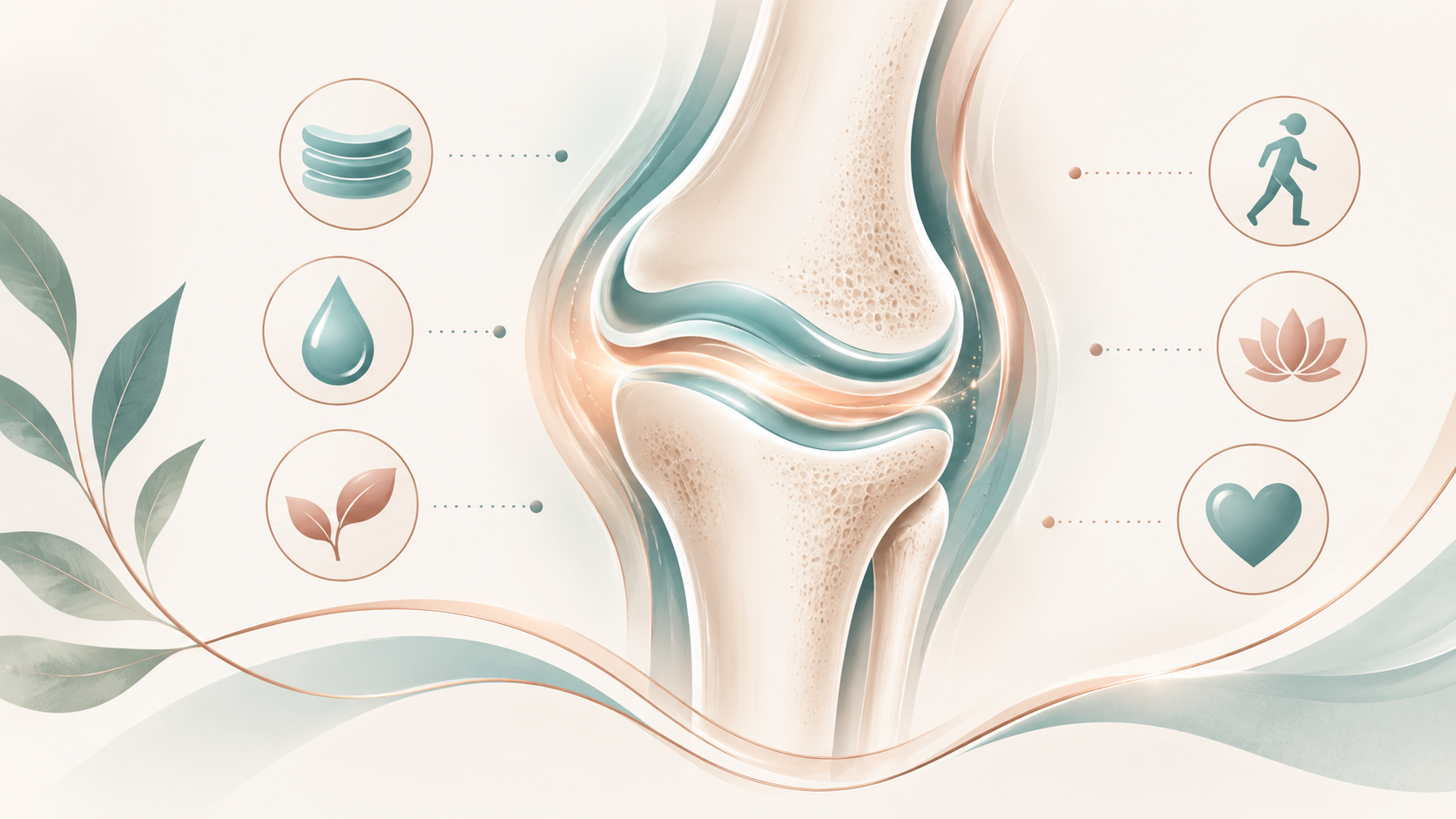
Think of estrogen as a quiet caretaker working inside your joints, day and night. Estrogen helps maintain the cartilage that cushions your joints, keeps inflammation in check, and supports the fluid that keeps your joints moving smoothly.
As estrogen begins to decline during perimenopause, cartilage can start to break down a little faster, and inflammation, previously kept quiet, can begin to rise. According to Mass General Brigham, when estrogen levels decrease during menopause, this can lead to more inflammation, which contributes directly to pain in the joints and muscles.
The New "Musculoskeletal Syndrome of Menopause"
In October 2024, researchers formally named a condition called "musculoskeletal syndrome of menopause." Harvard Health published a detailed piece on this in 2026, describing it as a newly recognised condition linking falling estrogen levels to widespread joint and muscle pain, stiffness, fatigue, and related symptoms, affecting an estimated 70 percent of women during perimenopause and menopause, and proving genuinely debilitating for nearly a quarter of them.
Which Joints Are Most Commonly Affected, and Why
The hands and fingers are often among the first to signal something has shifted, particularly morning stiffness making it hard to close a fist. The knees are another common site, especially going down stairs. Hips and shoulders tend to follow. Smaller joints with less surrounding muscle support can feel the loss of estrogen's protective effect earlier and more noticeably.
6 Warning Signs Your Joint Pain Is Hormonal, Not Just "Getting Older"
- Morning stiffness that eases as the day goes on. The first hour is the worst, and movement slowly loosens it.
- Pain that moves around your body. Knees this month, fingers the next, then a hip.
- It arrived alongside other perimenopause symptoms — poor sleep, hot flashes, or mood changes.
- Standard tests come back normal. Inflammatory markers and rheumatology panels show nothing amiss.
- It is worse during high-stress periods. Pressure at work or at home makes the ache louder.
- It responds, even slightly, to movement and rest. Gentle walking helps; long stillness makes it worse.
When to Seek Immediate Medical Care
Please contact your doctor promptly for sudden severe swelling in a single joint, redness or warmth with fever, joint pain following a fall or injury, or pain that prevents you from bearing weight.
Common Myths About Joint Pain in Midlife
"This is simply what happens when you get older."
This specific pattern is strongly hormonal, and it responds to nervous system support, movement, and for some women, hormone therapy.
"If my blood tests are normal, the pain is not real."
Normal tests usually mean the cause is hormonal inflammation, which standard rheumatology tests are not designed to detect. Your pain is real.
"I should rest completely until it goes away."
Movement and muscle strengthening can actually help, according to Mass General Brigham. Complete rest tends to deepen the stiffness.
How My RRR Method Applies to Joint Pain
Release
Your nervous system needs a safe way to release the chronic stress that keeps inflammation elevated — breathwork, EFT tapping, and simply naming out loud what is overwhelming you. If there is old anger sitting underneath it, releasing long-held resentment often changes how the body holds tension.
Rebalance
As the nervous system settles, inflammation has a genuine chance to reduce. Sleep, gentle food, and steady rhythm all belong here — and protecting your nights is one of the strongest anti-inflammatory steps available to you.
Rise
With calmer inflammation, movement starts to feel possible again — and possible movement is what rebuilds the muscle that supports your joints.
An EFT Tapping Practice to Try Today
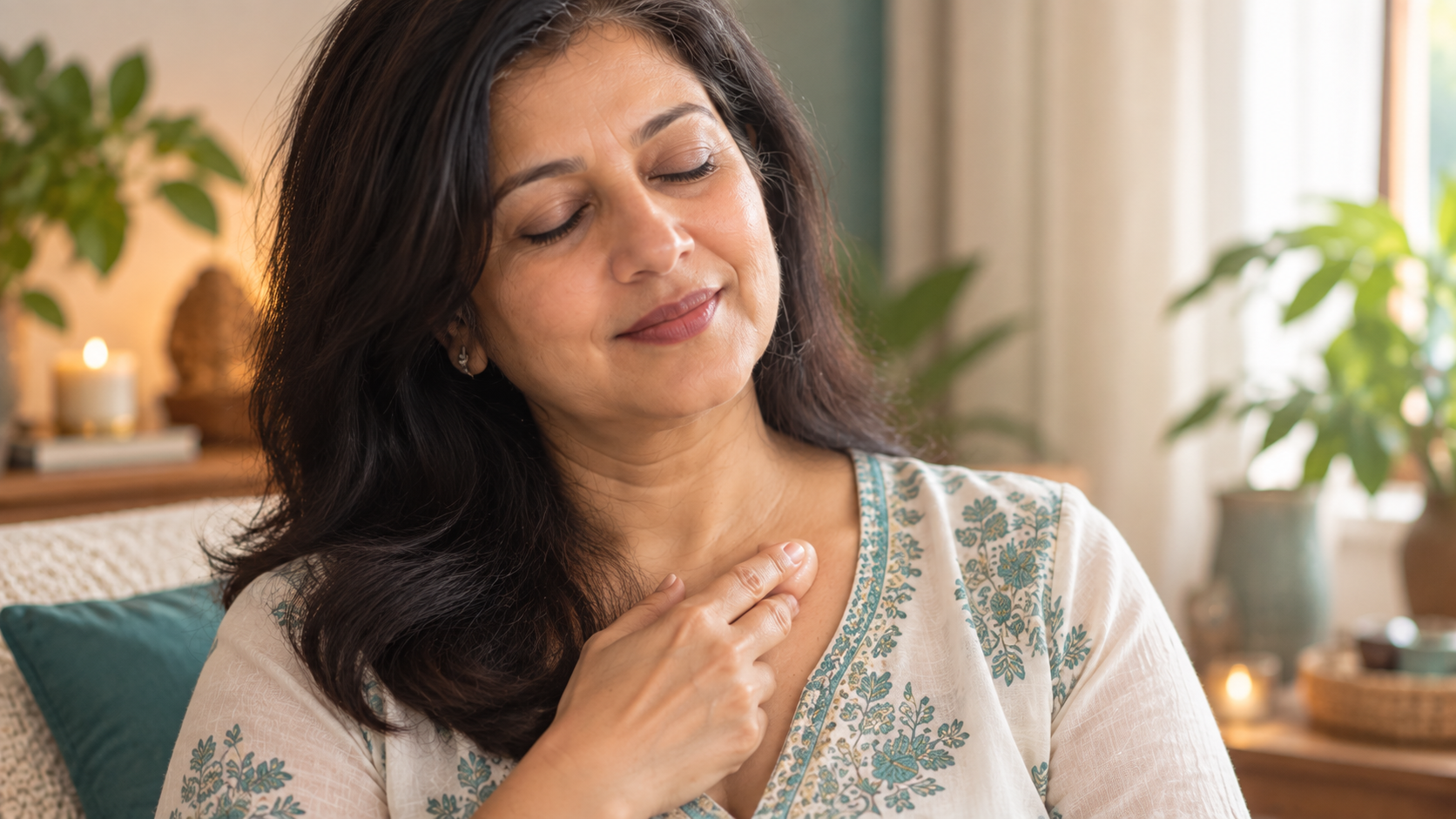
Tap the side of your hand (the karate-chop point) while saying: "Even though my joints feel stiff and I am frustrated by this, I deeply and completely accept myself and my body right now."
Then move through the tapping points — eyebrow, side of eye, under eye, under nose, chin, collarbone, under arm, top of head — repeating gently: "This stiffness in my joints."
Finish with one hand resting over the affected joint: "I am learning to work with my body, not against it."
A Ho'oponopono Practice for Making Peace With Your Body
Place both hands over the troubled joint, close your eyes, and slowly repeat: "I am sorry. Please forgive me. Thank you. I love you."
Repeat three or four times, breathing slowly between each round.
“Supporting your joints starts with calming your nervous system, not fighting your body.”
How This Typically Works
When a woman finally connects her joint pain to perimenopause, rather than continuing to search for other explanations, the confusion itself starts to lift almost immediately, even before physical relief begins.
As gentle daily movement, EFT tapping, and better sleep support are added consistently, inflammation tends to ease gradually over a few weeks. Most women report the pain stops controlling their whole day first, before it fully resolves. That is often the first real shift — understanding replacing confusion, and confidence slowly replacing fear.
Common Mistakes Women Make With Joint Pain in This Stage
- Assuming the pain is unrelated to hormones simply because periods are still regular
- Pushing through painful movement without any gentle modification
- Avoiding all movement out of fear, leading to further stiffness
- Not mentioning joint pain to their doctor at all
- Relying only on painkillers without addressing the underlying cause
- Comparing their current mobility to their 20s or 30s
Frequently Asked Questions
Why do my joints hurt more in perimenopause specifically?
Because declining estrogen reduces its natural anti-inflammatory and cartilage-protective effects, so inflammation rises and cushioning wears more quickly.
Is joint pain a recognised symptom of perimenopause?
Yes. Researchers have now named a specific condition for it, called musculoskeletal syndrome of menopause.
What is musculoskeletal syndrome of menopause?
It is a recently named condition linking falling estrogen to widespread joint and muscle pain, stiffness and fatigue, affecting an estimated 70 percent of women in this stage.
Can joint pain start before my periods become irregular?
Yes. For some women it begins in the mid-to-late thirties, well before any obvious change in cycle length.
Should I get tested for arthritis?
Yes, it is worth ruling out other causes, even though hormonal joint pain often will not show up on these tests.
Why did my doctor not mention hormones?
Many doctors receive limited training specifically in menopause-related symptoms, so the hormonal link is often missed rather than dismissed.
Does hormone replacement therapy help?
Some women find it helps their joint pain considerably. It is a decision to make with your doctor, based on your own history.
Can stress make hormonal joint pain worse?
Yes. Stress and inflammation are closely connected, so long stretches of pressure usually make the pain louder.
Will exercise make my joint pain worse?
Generally not. Gentle, consistent movement tends to reduce stiffness over time, while complete rest often increases it.
Is it normal for joint pain to move around my body?
Yes. Pain that shifts from knees to fingers to hips is one of the distinguishing patterns of hormonal joint pain.
Can weight gain make hormonal joint pain worse?
Yes, extra weight stresses weight-bearing joints, though joint pain also makes staying active harder — a cycle worth addressing gently rather than harshly.
Are supplements like fish oil helpful?
Some women find omega-3s helpful for inflammation. Please discuss any supplement with your doctor first.
Does joint pain from perimenopause ever go away completely?
For many women it improves once hormones stabilise after menopause, particularly alongside movement and nervous system support.
Can EFT tapping genuinely help with physical pain?
It reduces stress and the muscle tension surrounding pain, which can lessen how intensely the pain is experienced.
Is morning stiffness always a sign of arthritis?
No. Morning stiffness that eases as the day goes on is also a very common pattern in hormonal joint pain.
Should I be worried if my joint pain is severe?
Severe, sudden or rapidly worsening pain with swelling, redness or fever should be discussed with your doctor promptly.
Can better sleep actually reduce joint pain?
Yes. Poor sleep raises inflammation throughout the body, so protecting sleep is one of the most useful things you can do — and if you still wake up exhausted after eight hours, that is worth understanding too.
Does cold or heat therapy help?
Ice can help with swelling during a flare, and heat tends to ease general stiffness. Use whichever brings relief.
Is it common for joint pain to affect my hands specifically?
Yes. The hands and fingers are often among the first areas affected, especially first thing in the morning.
What is the first step I should take?
Track your symptoms alongside your cycle, mention this connection to your doctor, and begin gentle nervous system and movement support.

Your 7-Day Gentle Joint Ease Plan
- Day 1–2: Practice the EFT tapping sequence once daily, ideally in the morning.
- Day 3: Take a slow, gentle 15-minute walk.
- Day 4: Alternate a warm compress with gentle stretching before bed.
- Day 5: Write down your symptoms alongside your cycle pattern for your doctor.
- Day 6: Add 5 minutes of slow, mindful breathing.
- Day 7: Reflect on which practice felt most supportive, and continue for 21 days.
What You Can Do Next
- Start the 7-day gentle joint ease plan today
- Download the free Joint Ease Checklist
- If you'd like personalised support, book a free clarity call
- Read the hormones and nervous system chapter of Your Body Is Speaking
“Your joints are not betraying you, and you are not simply getting old before your time. Your body is moving through a genuine hormonal transition, and it deserves real understanding, not dismissal. Healing doesn't happen because we know more. Healing happens because we gently practice what truly supports our body, one day at a time. You are much, much more powerful than what you think you are.”
With warmth,
Meghalatha
References
- Mass General Brigham — Menopause and Joint Pain
- The Menopause Charity — Joint Pain and Muscles
- Harvard Health Publishing — Musculoskeletal Syndrome of Menopause
This work supports emotional wellness and is not a substitute for professional medical care. Persistent or severe joint pain deserves proper assessment — please speak with your doctor.