
Why You Can't Let Go of the Anger (And What Carrying It Is Doing to Your Body)
By Meghalatha Gopal · Self-Healing Mentor & Author of Your Body Is Speaking

If someone has told you that you "just need to forgive and move on," I want you to pause before you accept that advice. Most of us were handed a completely wrong definition of forgiveness — and that wrong definition is exactly what has kept us stuck for years.
Forgiveness does not mean what happened was okay. It is not something you do for the other person. And it is certainly not a switch you flip because somebody told you it was time.
Maybe you are still carrying something from years ago. A parent who never said sorry. A partner who broke your trust. A friend who walked away without explanation. A sister you have not spoken to since a wedding nobody talks about now. You have tried to let it go. You have told yourself you are over it. And then something small happens — a name, a photograph, a song — and you feel your chest tighten all over again.
Can you relate?
If you can, please hear this first: there is nothing wrong with you. You are not bitter, and you are not weak. You are carrying something your body was never designed to hold for this long.
Let us talk about what forgiveness actually is, what happens inside your body while you withhold it, and a simple daily practice you can begin today.
Prefer to listen? I walk through the whole practice here.
What forgiveness is NOT
Before we can redefine forgiveness, we have to clear away everything it has wrongly come to mean. This is where most women get stuck and give up on the whole idea.
It is not condoning the behaviour. Forgiving someone does not mean excusing what they did, minimising it, or rewriting the story so it hurts less. What happened, happened. You are allowed to hold that as true forever.
It is not reconciliation. You do not have to let that person back into your life. Forgiveness and access are two completely separate decisions. You can fully forgive someone and still choose never to speak to them again.
It is not forgetting. There is no delete button for memory, and you do not need one. The memory is allowed to stay. It is the emotional charge attached to the memory that we are releasing.
It is not letting them off the hook. This is the biggest misunderstanding of all. Forgiveness was never about their accountability. There is no hook to remove them from. This work is about your nervous system, not their consequences.
Once this clears, forgiveness stops feeling like a moral concession you are being asked to make. It starts feeling like something you are doing for yourself.
Key takeaway: You are not being asked to say it was fine. You are being asked to stop paying for it.
What forgiveness actually is
Here is the definition worth holding onto:
“Forgiveness is releasing the emotional charge from your own nervous system.”
That is all of it. It has nothing to do with the other person. They may never know this work is happening. Forgiveness is an internal event, not a conversation.
This is where it becomes interesting. When you replay a hurt — rehearsing the argument in the shower, rewriting what you should have said, reliving the betrayal at two in the morning — your body does not clearly distinguish between that memory and the original event. It responds much the same way. Stress hormones such as cortisol rise. Your body shifts into a low, humming version of fight-or-flight.
Think of it like a mobile phone with one app running in the background all day. You cannot see it. You are not using it. But by evening the battery is gone and you cannot understand why. Unresolved resentment is that app.
Research has linked rumination — the mental loop of going over and over a hurt — with raised cortisol, disturbed sleep and higher inflammatory markers. Your body is built for short bursts of stress followed by recovery, not for a threat that stays switched on for years.
So withholding forgiveness does not only keep the memory alive. It keeps your body's response to that memory alive, on a loop, in the background, every single day.
One small thing you can try today: notice once, without judging yourself, when your mind starts rehearsing an old conversation. Just notice. Say quietly, "there it is." Noticing is where all of this begins.
Key takeaway: The loop is not a character flaw. It is a nervous system that has not been told the danger has passed.
The real cost of carrying resentment
Resentment is expensive — and the cost is not only emotional. It is physical.
Every time you carry anger toward someone, your body stays braced. The jaw tightens. The shoulders creep up toward the ears. The breath stays shallow and high in the chest instead of dropping into the belly. The gut, which is deeply wired to emotional state, responds to that same signal by speeding up or slowing down.

Unprocessed grief behaves the same way. It does not simply fade because years have passed. It settles into the tissue and waits.
One pattern I see again and again in women in their forties and fifties: anger carried toward a parent, an ex-partner, or a friend who broke trust a decade ago — and a body that has been quietly billing them for it the whole time. The bill arrives as fatigue that sleep does not touch. As shoulders that will not soften. As a nervous system that never quite exhales.
If your shoulders and neck have been holding tension for years, there is often an emotional story sitting underneath the physical one. And if you are exhausted no matter how long you sleep, it is worth understanding why eight hours still leaves you tired — because a body in a permanent low-grade threat state does not rest, even while sleeping.
None of this means you are weak for still feeling it. It means you have been strong for a very long time, in a way nobody thanked you for.
Key takeaway: Your body has been keeping the account open. Forgiveness is how you close it.
Common myths worth setting down
"Time heals everything."
Time alone does not process emotion. Time plus practice does. Plenty of women are carrying something from twenty years ago as freshly as the week it happened.
"If I forgive, I am saying it did not matter."
The opposite is true. You only need to forgive things that mattered enormously.
"I should be over this by now."
There is no schedule. The idea that grief or anger has a deadline causes far more suffering than the original hurt in many cases.
"Forgiving means I have to talk to them."
No. You never have to make contact. This can be done entirely in a quiet room, alone.
"I have tried and it did not work, so I cannot do it."
Usually what was tried was deciding to forgive, mentally, once. That is not a practice. A practice is small and repeated.
Ho'oponopono — a gentle release practice
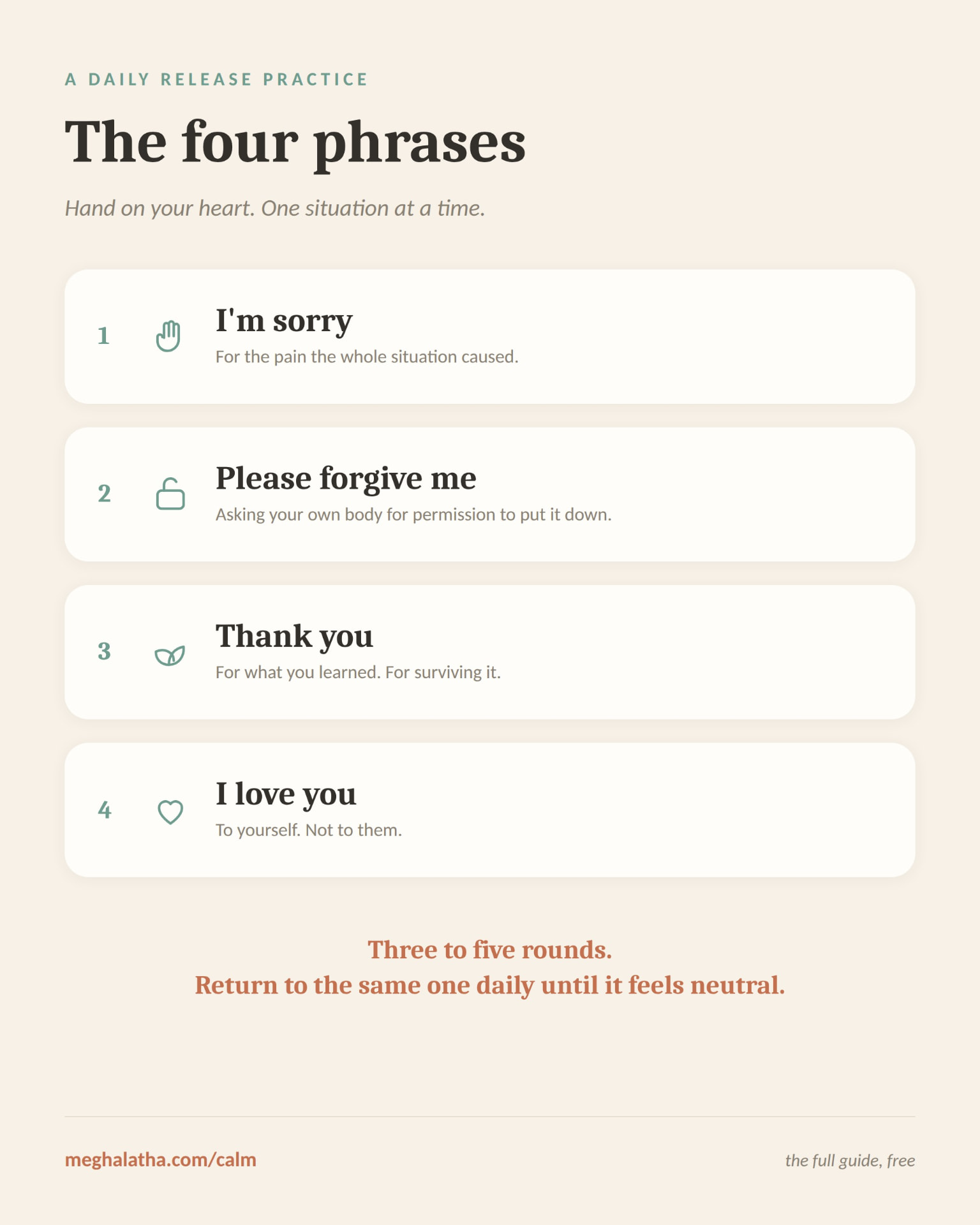
Here is the practice, done together.
So how do you actually release it?
There is a Hawaiian forgiveness practice called Ho'oponopono, built around four simple phrases. I think of it less as a mindset and more as a sequence the nervous system recognises — something closer to a reset than a decision.
The four phrases are:
"I'm sorry." Not necessarily an apology to the other person. This is an acknowledgement of the pain the situation caused — including any part of you that carried blame, or let it sit and harden.
"Please forgive me." Directed inward, toward your own capacity to release. You are asking your own system for permission to finally put this down.
"Thank you." Gratitude — for what you learned, for your own resilience, for having survived it at all. This phrase begins moving the nervous system out of threat and toward safety.
"I love you." Directed at yourself. This is where the real work happens. Self-compassion settles the stress response in a way self-criticism never has and never will.
Said slowly, in order, with a hand resting on your heart, these four phrases move you out of the mental loop of rehearsing the hurt and into a felt sense of release in the body.
This is exactly why this practice sits at the centre of the Release phase of my RRR Method™ — Release, Rebalance, Rise. You cannot rebalance a body that is still braced. Release always comes first.
Your simple daily practice
Here is how to begin, today.
- Pick one situation. Just one. Trying to forgive an entire history in a single sitting is how most people quit before they start.
- Sit somewhere quiet. Place one hand on your heart. Let your shoulders drop.
- Bring the situation to mind — not to relive the details, only enough to notice where it sits in your body. Chest? Throat? Stomach? Just notice.
- Say the four phrases slowly, out loud if you can: I'm sorry. Please forgive me. Thank you. I love you.
- Repeat three to five times. You may feel nothing the first time. You may feel a great deal. Both are completely normal.
- Return to the same situation daily until it feels neutral to think about. Then move to the next one.
This is a practice, not a one-time fix. The nervous system releases in layers, the way an onion comes apart — not all at once.

A story I often think about
A woman came to me carrying anger toward her mother that was more than twenty years old. Her mother had since passed away. She said, almost apologetically, "There is no point to this. I cannot even have the conversation now."
That belief — that forgiveness requires the other person to be available — had kept her holding it for two decades.
She began the practice with that one situation. Five minutes, most mornings. For the first week she felt nothing and told me it was not working. In the third week she rang me and said she had slept through the night for the first time in a very long while, and had not connected the two things until that morning.
Her mother had not changed. The past had not changed. Her body had simply been allowed to stand down.
Common mistakes women make
Trying to forgive everything at once. One situation at a time. Always.
Waiting to feel ready. Readiness arrives through the practice, not before it.
Judging the practice by the first attempt. The first few times often feel mechanical or empty. That is normal and it is not failure.
Confusing forgiveness with reconciliation. You can release the charge and keep the door closed. Both at once.
Doing it in your head while rushing. Hand on heart, slow breath, out loud where possible. The body needs to be included — that is the entire point.
Believing you must forgive yourself last. For many women, the person hardest to forgive is themselves. Start there if that is true for you.
Frequently asked questions
How long does it take to forgive someone?
There is no fixed timeline. Some situations soften in a week of daily practice; others carried for decades take months. The measure is not how long it takes but whether it feels lighter than it did last month.
Can I forgive someone who has died?
Yes. This work happens entirely within your own nervous system, so the other person's presence — or existence — is not required. Many women find this is the release they most needed.
What if I do not want to forgive them?
That is completely allowed, and you are not a bad person for feeling it. When you are ready, it may help to remember you are not doing this for them. You are doing it so your body can stop paying.
Is forgiveness the same as letting someone back into my life?
No. Forgiveness and access are separate decisions. You can release the emotional charge entirely and still maintain a firm boundary.
Can holding resentment really affect my physical health?
Chronic stress affects the body in well-documented ways — sleep, digestion, muscular tension, inflammation. Long-held resentment keeps the stress response engaged, so it is reasonable to treat it as a physical matter as well as an emotional one.
Why do I feel angry again after I thought I had let it go?
Release happens in layers. A fresh wave usually means a deeper layer has surfaced, not that your earlier work was undone.
Do I have to say the phrases out loud?
Out loud is more effective because your body hears your own voice, but silently is far better than not at all. Do what your situation allows.
Can I do this practice for myself rather than another person?
Yes, and for many women this is the most important version. Place your hand on your heart and direct all four phrases inward.
Is this connected to my mood swings and irritability?
It can be. A nervous system already braced by old resentment has far less room for daily frustration. If your moods have shifted lately, understanding what is happening with perimenopause mood swings is a useful next step.
How do I know if this is grief, anger, or something more serious?
If low mood, hopelessness or loss of interest has been present most days for more than two weeks, please speak with a doctor or a qualified mental health professional. It is also worth reading about the difference between perimenopause and depression. This practice supports emotional wellbeing; it does not replace professional care.
Will this help me sleep better?
Many women notice sleep is the first thing to change, because a settled nervous system stops rehearsing at night. If waking through the night is your main struggle, this may help too.
What if I start crying during the practice?
That is release, not a problem. Let it happen, keep your hand on your heart, and stop whenever you need to. You can always return tomorrow.
Your 7-day gentle release plan
Day 1 — Choose one situation. Write one sentence about how it sits in your body. Nothing more.
Day 2 — Hand on heart. Four phrases, three rounds. Notice what happens.
Day 3 — Same situation, same practice. Add one slow exhale before you begin.
Day 4 — Repeat. Afterwards, write one line: what feels different, even slightly?
Day 5 — Repeat. Today, direct the four phrases toward yourself instead.
Day 6 — Repeat with the original situation. Notice whether the charge has moved.
Day 7 — Sit quietly and reflect: is this lighter than it was on Monday? If yes, continue. If not, continue anyway — layers take time.
Reflection questions
- What am I still carrying that I have never named out loud?
- Where does it live in my body?
- What would change in my week if this were 10% lighter?
- Who would I be without this weight?
If you would rather not do this alone
Some things are easier to release with someone sitting beside you. If you have been carrying something for years and it has not shifted, that is not a failure of effort — it usually just means it was never meant to be done in isolation.
If you would like support, you are welcome to book a free clarity call and we can talk about where you are and what a next step might look like. There is no pressure and nothing to prepare.
You may also like my free guide, 5 Things Every Woman Over 40 Should Know About Her Body, for gentle daily practices that settle the nervous system.
A personal note from me
I know how heavy this can be. I know what it is to carry something for years and to be told, kindly and uselessly, to just let it go. Nobody ever explains how.
So please do not try to forgive everything this week. Choose one situation. Put your hand on your heart. Say four sentences. That is enough for today, and it is genuinely more than most people ever do.
You are much, much more powerful than what you think you are.
Healing doesn't happen because we know more. Healing happens because we gently practise what truly supports our body, one day at a time.
With warmth,
Meghalatha
This article supports emotional wellbeing and is not a substitute for professional medical or mental health care. If you are struggling, please speak with a qualified professional.