What Is Siddha Mudra? 5 Shocking Ways Healing Hand Positions Calm Your Body and Mind
By Meghalatha Gopal · Self-Healing Mentor & Author of Your Body Is Speaking
Try a Siddha Mudra Right Now (30 Seconds)
Before we go into the details, I want you to try something.
Wherever you are sitting, gently touch the tip of your thumb to the tip of your index finger. Keep the other three fingers relaxed and long.
Close your eyes. Take one slow breath, and let the exhale be longer than the inhale.
That is it. You have just practised a Siddha mudra.
Notice what happened. Did your shoulders drop even a little? Did the mind pause, even for a second? That small pause is exactly what this article is about.
Does Any of This Sound Familiar?
- A mind that races at night, even when your body is exhausted
- Shoulders, jaw and neck that never quite let go
- Digestion that feels sluggish or unsettled when you are stressed
- Days that feel flat, low and drained of energy
- A wish for something simple, free and gentle you can do for yourself
If you nodded at even two of these, keep reading. Siddha mudra may be the quiet practice you have been looking for.
What Is Siddha Mudra?
The word "mudra" comes from Sanskrit and is commonly understood as a seal or a gesture. A mudra is a specific position of the hands, or sometimes the whole body, held with attention and breath.
"Siddha" refers to the Siddhars. These are the realised masters of the Tamil tradition, the same lineage that gave us Siddha medicine and works such as Thirumoolar's Thirumandiram.
So Siddha mudra simply means the healing hand positions that come from this Siddhar way of seeing the human being.
Why the Siddhars Cared About Hands
For the Siddhars, health was never only about the body. They saw the body, the breath, the mind and the spirit as one connected whole.
Within this view, the hands are not just tools for cooking and typing. They are considered a very concentrated map of the body, and a place where we can gently influence how we feel inside.
This is a traditional understanding. It is a beautiful framework to practise within, and it is worth knowing where it comes from, so we respect the tradition rather than treat it as a trend.
The Five-Element Map of Your Fingers
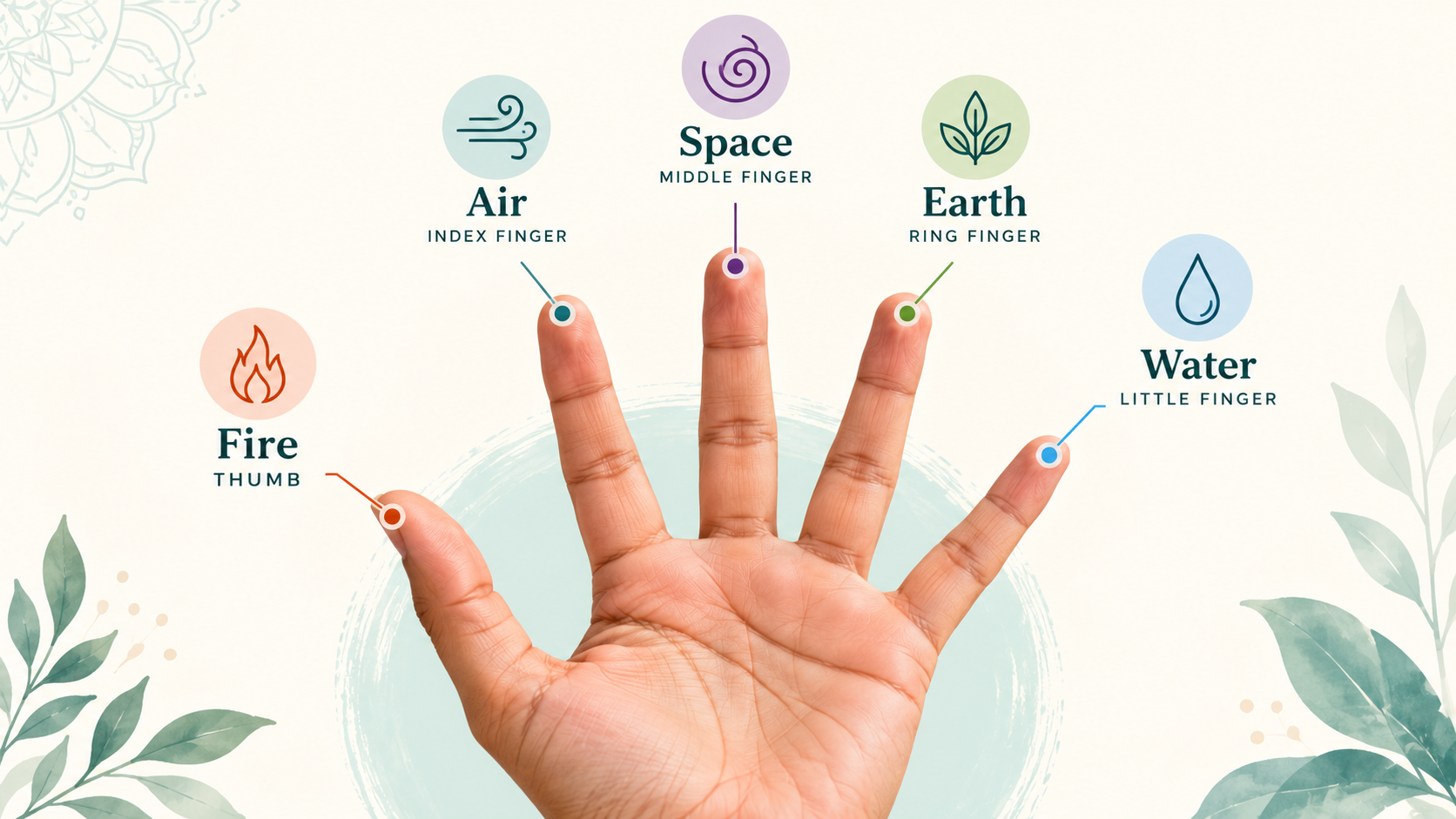
In the traditional view, each finger is linked with one of the five elements.
- Thumb: fire (Agni)
- Index finger: air (Vayu)
- Middle finger: space (Akasha)
- Ring finger: earth (Prithvi)
- Little finger: water (Jala)
When you bring fingertips together in a specific pattern, the traditional understanding is that you are balancing these elements within yourself. For example, joining the thumb (fire) with another finger is a way of "meeting" that element with your own inner energy.
You do not have to believe in the element map for the practice to be useful. Many women simply find the shapes easy to remember and the ritual calming.
What Siddha Mudra Is Not
I like to be very clear and honest with you, because this is a space where people often overpromise.
Siddha mudra is not a cure for any disease. It does not replace your doctor, your tests or your medicines.
It is a gentle, supportive practice that works on the one thing we can influence every single day: how safe and settled our nervous system feels.
If you have any health condition, please continue your treatment and speak to your doctor before making changes. Mudra can walk alongside medical care. It should never replace it.
How Does Siddha Mudra Work? (Simple Science)
Let me explain this the way I would explain it to a friend sitting across from me.
A Steady Point of Focus for a Busy Mind
When you hold a mudra, your mind has one simple, steady thing to rest on: the touch of your fingertips.
Anyone who has tried to "stop thinking" knows how impossible that is. But giving the mind one gentle task, such as feeling the contact between two fingers, is much easier. This is why mudra is often paired with meditation.
Your Hands Are Rich in Nerve Endings
Your fingertips have a very dense supply of sensory nerve endings. When you hold a light, steady touch with full attention, you are sending your brain a clear, repeated and calming signal.
Think of it like holding a friend's hand during a difficult moment. Nothing was "fixed", but something inside settled.
Slow Breathing Does the Heavy Lifting
Here is the part I want you to remember. A mudra is almost always practised together with slow, steady breathing, and slow breathing, especially with a longer exhale, is well known to activate the part of the nervous system responsible for rest and repair.
This is the same system that gets switched off when we live in constant low-grade stress. A calmer nervous system supports better sleep, steadier digestion, clearer thinking and more balanced emotions.
“So the mudra works less like a magic switch and more like a doorway. It helps you walk into a calm state again and again, in a consistent manner.”
What Research Currently Says
Honest note: research on specific hand mudras themselves is still limited and mostly small in scale. The stronger evidence is for the ingredients that come with the practice, namely slow breathing, focused attention and regular relaxation. These are well studied for stress, mood and sleep.
So I present Siddha mudra as a supportive, low-risk practice, and I invite you to try it and observe your own body.
3 Example Siddha Mudras for Body and Mind
You do not need to learn fifty mudras. In my experience, three simple ones, practised regularly, will give you far more than a long list you never repeat.
I have chosen these three because they are simple, safe, and cover both the physical and the mental side.
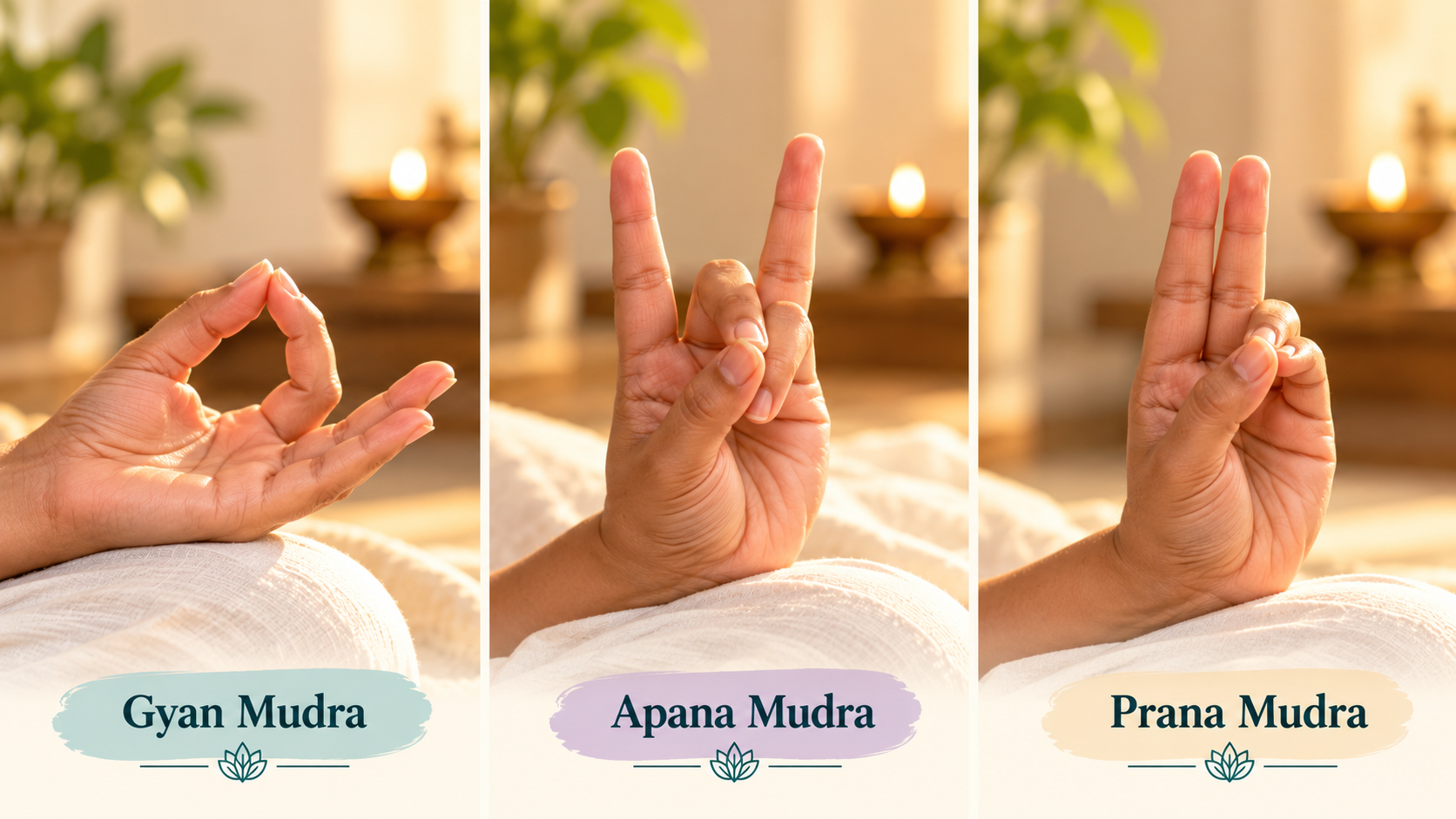
Mudra 1: Gyan Mudra (Mudra of Knowledge)
How to do it:
- Sit comfortably with your spine tall but not stiff.
- Touch the tip of your thumb to the tip of your index finger.
- Keep the other three fingers relaxed and gently extended.
- Rest your hands on your knees. Palms up feels more receptive, palms down feels more grounded.
- Breathe slowly, exhaling a little longer than you inhale.
How long: 5 to 10 minutes.
For the mind: Traditionally used for focus, clarity and quietening restless thoughts. Many women find it helpful when the mind is racing at night or when worry is humming in the background.
For the body: Because it is practised with slow breathing, it supports relaxed shoulders, a softer jaw and a steadier heartbeat.
Best time: Morning for focus, or just before sleep to wind down.
Mudra 2: Apana Mudra (Mudra of Release)
How to do it:
- Sit comfortably with your back supported.
- Bring the tips of the thumb, middle finger and ring finger together.
- Keep the index and little fingers gently extended.
- Rest the hands on your knees and breathe slowly.
How long: 10 to 15 minutes.
For the body: "Apana" is associated with downward-moving energy, the energy of letting go. Traditionally, this mudra is used to support digestion and elimination, especially when you feel heavy, bloated or sluggish.
For the mind: Beautiful when you feel emotionally cluttered, or when you are holding on to things you cannot seem to release.
Best time: In the evening, or after your meal has settled (not immediately after eating).
Mudra 3: Prana Mudra (Mudra of Life Energy)
How to do it:
- Sit comfortably and relax your shoulders.
- Touch the tips of the thumb, ring finger and little finger together.
- Keep the index and middle fingers gently extended.
- Breathe slowly and deeply into the belly.
How long: About 10 minutes.
For the body: Traditionally practised when you feel low on energy, tired or flat. It is used to support vitality and a feeling of strength.
For the mind: A gentle companion when you feel low, unmotivated or emotionally drained.
Best time: Morning.
Quick Comparison: Which Mudra When?
- Restless mind or trouble winding down: Gyan Mudra
- Heavy, sluggish digestion or emotional clutter: Apana Mudra
- Low energy, flat mood: Prana Mudra
How to Practise Siddha Mudra Safely
A few simple guidelines make the practice both comfortable and effective.
7 Gentle Rules for Practice
- Do not press hard. A soft touch is enough.
- Sit comfortably. Spine tall, shoulders relaxed. You can sit on a chair.
- Use both hands. Unless a particular practice says otherwise.
- Breathe slowly. Let the exhale be longer than the inhale.
- Choose a quiet time. Even five minutes is fine.
- Be consistent, not extreme. Ten calm minutes daily beats one long tiring hour weekly.
- Stop if you feel dizzy, uncomfortable or unwell. Your body always has the final word.
If you are pregnant, have a medical condition or are on regular medication, please speak to your doctor before starting any new practice.
Common Myths About Siddha Mudra
It's time to bust a few myths.
Myth 1: Mudras Are Only for Yogis and Saints
The fact: Mudras are for anyone who can sit quietly for a few minutes. You do not need special clothes, a special place or special knowledge.
Myth 2: If I Hold the Mudra, My Problem Will Disappear
The fact: Mudras support your body and mind, but they work best alongside rest, nourishing food, movement and medical care when it is needed. Please continue your treatment and speak with your doctor about any health condition.
Myth 3: The More I Practise, the Faster It Works
The fact: Consistency matters more than length. A small daily practice teaches your nervous system a new habit of calm. Overdoing it only makes it one more thing on your to-do list.
Myth 4: I Must Believe in It for It to Work
The fact: You do not need a belief system. You only need to be willing to sit, breathe and observe how you feel. Many of the benefits come from the breathing and the focused attention themselves.
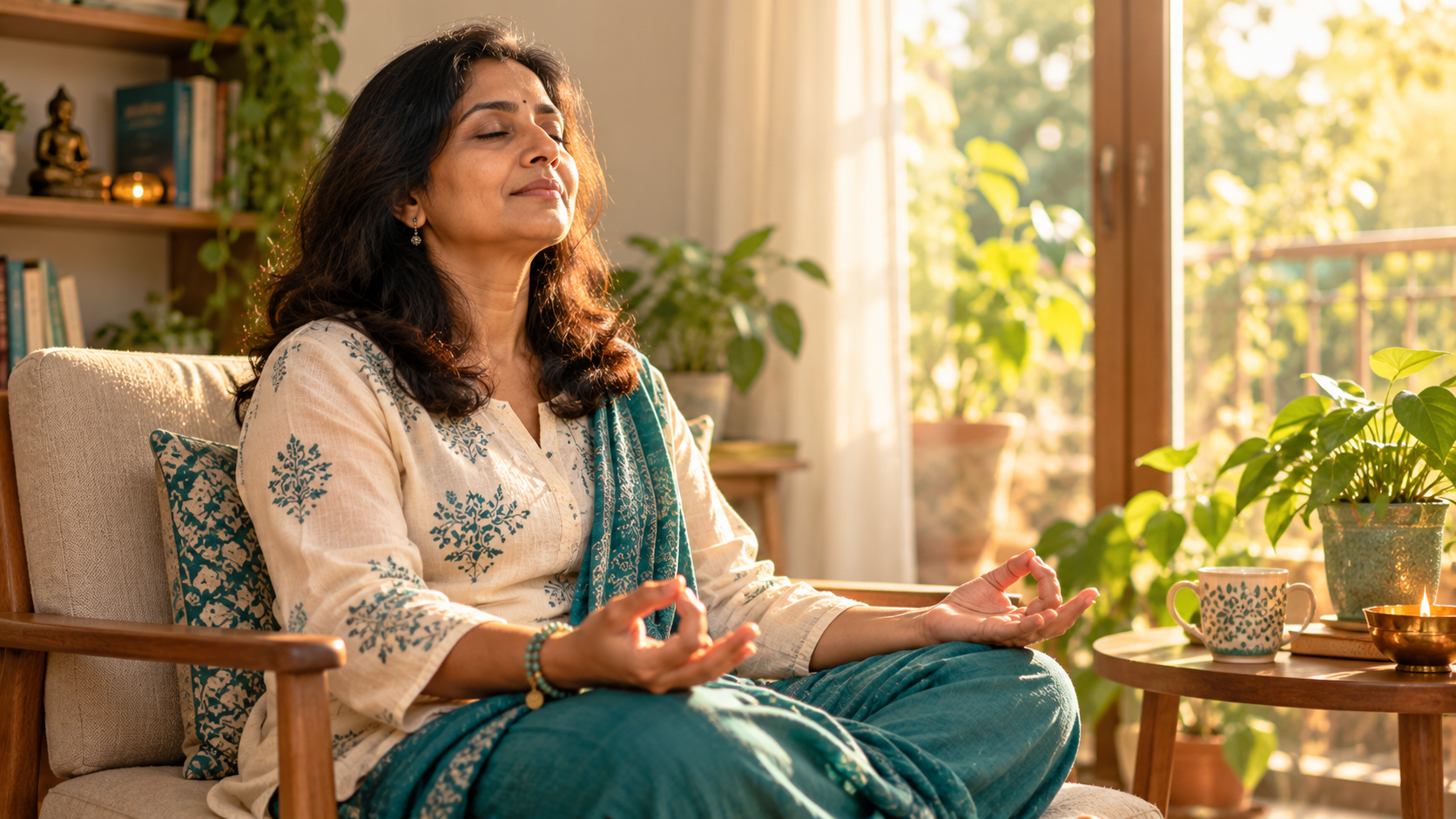
The Self-Healing Framework: RRR Method™ and Siddha Mudra
Siddha mudra is one of the tools I use inside my RRR Method™, which stands for Release, Rebalance, Rise.
Release
Use your mudra as a pause button. Hold it, breathe, and let the day's tension leave your body on every exhale.
Rebalance
As your breath slows and your nervous system settles, your sleep, digestion and mood get a real chance to find their natural rhythm again.
Rise
Over days and weeks, you begin responding to life from a calmer place rather than reacting from stress. That is what rising looks like. It is quiet, steady and real.
How This Typically Works: A General Pattern I See
Let me describe what I commonly see, because I think you will recognise yourself in it.
Most women I speak to feel they have no time for themselves. So when I suggest a practice, the first reaction is often, "Megha, I cannot sit for thirty minutes."
And that is perfectly fine, because mudra does not ask for that.
What usually happens is that women begin with just five minutes before sleep: a mudra and slow breathing. Within the first couple of weeks, small things are noticed first. The mind quietens a little faster at night. The shoulders are less tight. There is a little more patience with the people they love.
Not dramatic. Not overnight. But steady.
And that steadiness is exactly what we are after, because lasting healing is built from small, repeated moments of safety.
A Brief Look at the Siddhar Tradition
To practise mudra with respect, it helps to know a little about where it comes from.
The Siddhars of Tamil Nadu
The Siddhars are revered in Tamil culture as sages who explored the nature of the body, breath, mind and consciousness. Traditionally, eighteen major Siddhars are spoken of, with names such as Agastya, Bogar and Thirumoolar.
Their teachings were composed in Tamil verse, often in simple but layered language, and passed on through lineages of students.
Siddha Medicine and the Whole Person
The Siddha system of medicine, which is recognised in India today under the Ministry of AYUSH, grew from this tradition. It looks at a person as a whole: the body, the mind, the habits, the environment and the inner life.
Practices such as breath awareness, meditation and mudra were seen as ways of keeping this whole person in balance, not only of treating illness.
Why This Matters for You
You do not need to study ancient texts to benefit from mudra. But knowing that this practice comes from a long, thoughtful tradition can help you approach it with patience and respect, rather than as a quick fix.
Mudra and Emotional Healing
Many women tell me that the biggest change they feel from mudra practice is emotional, not physical.
Why Emotions Show Up in the Body
Stress, worry, grief and resentment do not stay in the mind. They show up as a tight chest, a clenched jaw, shallow breathing or heavy shoulders.
When you sit with a mudra and slow breathing, you give those held sensations space to be noticed and softened.
A Simple Emotional Check-In During Practice
- Notice: where in my body do I feel tension right now?
- Name: what emotion might be sitting there? (worry, sadness, anger, tiredness)
- Breathe: send a slow exhale towards that area.
- Allow: you do not have to fix anything. Just let it be there, gently.
Done regularly, this builds emotional awareness. And awareness is the first step of Release in the RRR Method™.
When to Seek Extra Support
If you notice persistent low mood, anxiety that interferes with daily life, or very strong emotions that overwhelm you, please speak to a doctor or qualified mental health professional. Mudra is a gentle companion, not a replacement for professional help.
Why Siddha Mudra Matters in Midlife
If you are a woman in your late thirties, forties or fifties, your body is going through a lot. Hormones shift, sleep changes, responsibilities pile up, and stress rarely switches off.
The Stress Load of Midlife
Many women in this stage are caring for children, ageing parents, a career and a home at the same time. The nervous system stays on high alert for years.
When that happens, the body finds it harder to rest, digest and recover. Sleep becomes lighter. Mood becomes more sensitive. Small things feel big.
Where Mudra Fits In
Siddha mudra does not change your responsibilities. What it does is give you a few minutes, several times a week, where your nervous system is invited to stand down.
It is free, needs no equipment, and can be done on a chair, on your bed, or even in a parked car before you walk into the house.
Think of it as a small deposit into your calm account. A few minutes a day, and over time the balance grows.
Gentle Support for Common Midlife Complaints
Please remember, these are areas where a calmer nervous system may help. They are not promises or treatments.
- Restless nights: a slow-breathing mudra practice before bed can help the mind wind down (see also why you wake at 3am in perimenopause)
- Irritability and mood swings: a pause button between trigger and reaction
- Tension in the neck, shoulders and jaw: relaxed breathing softens the body's guarding
- Sluggish digestion under stress: relaxing helps the body move into rest-and-digest mode
- Low energy and flat days: a morning practice can set a steadier tone, and it supports the stress side of stubborn midlife weight too
Going Deeper: Mudra, Breath and Intention
A mudra on its own is lovely. A mudra combined with breath and a gentle intention becomes a complete practice.
Step 1: Settle the Body. Sit comfortably. Let your shoulders drop away from your ears. Soften your jaw and the space between your eyebrows.
Step 2: Form the Mudra. Make the hand position gently. If your fingers begin to tense, release and begin again. The touch should feel light, like holding a feather.
Step 3: Lengthen the Exhale. Breathe in through the nose for a count of four. Breathe out slowly for a count of six. There is no need to force it. If the count feels strained, shorten both.
Step 4: Add a Silent Intention. With each exhale, silently repeat a short line such as:
- "I am safe."
- "I can let go."
- "I have enough energy for today."
Choose the line that matches the mudra you are practising. This is where the mind and body begin to work together.
Step 5: Close Gently. When you are done, release the hands, rub your palms together until they feel warm, and rest them over your closed eyes for a moment. Open your eyes slowly and take one more breath before you stand.
How to Make Siddha Mudra a Daily Habit
The real magic of mudra is in the repetition. Here is how to make it easy.
5 Ways to Build the Habit
- Attach it to something you already do. After your morning tea, or after brushing your teeth at night.
- Start tiny. Five minutes is enough. If five feels too long, begin with two.
- Keep a fixed spot. The same chair or the same corner of your bed tells the body "it is time to calm down."
- Set a soft reminder. A gentle phone alarm, not a harsh one.
- Celebrate showing up. The goal is not a perfect session. The goal is to sit.
What You Might Notice (And What You Might Not)
In the first few days, some women feel calm quickly. Others feel restless, bored or even emotional. All of this is normal.
If your mind wanders, that is not failure. Every time you notice and gently return to the touch of your fingers, you are practising the skill itself.
Do not judge the practice by one session. Observe over two weeks.
Where Siddha Mudra Fits With Other Healing Practices
Siddha mudra sits comfortably alongside the other tools I teach and use in my RRR Method™.
- EFT tapping: helpful when emotions feel intense and need an outlet
- Ho'oponopono: a gentle forgiveness practice that pairs beautifully with Apana Mudra
- Breathwork: the natural partner of every mudra
- Chakra healing: many women enjoy combining mudra with chakra awareness
- NLP: reframing the thoughts that keep the nervous system on edge
You do not have to do everything. Choose what feels natural, and begin there.
Common Mistakes When Starting Siddha Mudra
6 Mistakes to Avoid
- Pressing the fingers too hard. Tension defeats the purpose.
- Holding your breath. Always keep breathing slowly and naturally.
- Expecting instant results. Give it at least two weeks before judging.
- Practising only when stressed. A daily habit works better than an emergency tool.
- Collecting too many mudras. Master two or three before adding more.
- Skipping medical advice. Mudra supports care. It does not replace it.
Your 7-Day Siddha Mudra Plan
- Day 1: Sit quietly for 5 minutes in Gyan Mudra with slow breathing. Just notice how you feel.
- Day 2: Gyan Mudra again, this time just before sleep.
- Day 3: Apana Mudra for 10 minutes in the evening.
- Day 4: Prana Mudra for 10 minutes in the morning.
- Day 5: Practise your favourite of the three, and add a silent line: "I am safe, I can let go."
- Day 6: Practise two mudras back to back, Apana and then Gyan, with a few slow breaths in between.
- Day 7: Sit for 10 minutes in the mudra your body asks for. Reflect: what changed in my mind this week?
Watch: What Is Siddha Mudra?
If you prefer to follow along on screen, watch the full video above, where I demonstrate each mudra step by step.
Frequently Asked Questions
What is Siddha mudra?
Siddha mudra refers to the healing hand positions that come from the Tamil Siddhar tradition. They are held with attention and slow breathing to help calm the body and mind.
What does the word "mudra" mean?
"Mudra" is a Sanskrit word commonly understood as a seal or gesture. In practice, it usually means a specific position of the hands.
Who were the Siddhars?
The Siddhars were realised masters of the Tamil tradition. They are associated with Siddha medicine and with texts such as Thirumoolar's Thirumandiram.
Can Siddha mudra cure diseases?
No. Siddha mudra is a supportive practice, not a cure. It does not replace medical care, tests or medicines.
How does Siddha mudra help the body?
Held with slow breathing, a mudra helps the nervous system move into a rest-and-repair state. This may support relaxed muscles, steadier breathing and a calmer heartbeat.
How does Siddha mudra help the mind?
It gives the mind one gentle point of focus, which may ease racing thoughts, worry and restlessness.
Is there scientific proof that mudras work?
Research on specific hand mudras is still limited and mostly small. The stronger evidence is for slow breathing, focused attention and regular relaxation, which are part of the practice.
What are the five elements linked to the fingers?
Traditionally: thumb with fire, index finger with air, middle finger with space, ring finger with earth and little finger with water.
What is Gyan Mudra good for?
Traditionally it is used for focus, clarity and calming restless thoughts. It is a good place to start.
What is Apana Mudra good for?
Traditionally it is used to support digestion and elimination, and to help with a feeling of emotional letting go.
What is Prana Mudra good for?
Traditionally it is used to support energy and vitality, especially when you feel tired or low.
How long should I hold a mudra?
Five to fifteen minutes is a good range. If that feels long, begin with two to five minutes and build slowly.
What is the best time of day to practise?
Morning suits Gyan and Prana Mudra. Evening or before sleep suits Gyan and Apana Mudra. Choose the time you can keep up consistently.
Can I practise on a chair?
Yes. A comfortable chair with your feet on the floor and your spine tall works perfectly.
Do I need to use both hands?
In general, yes, both hands. Use whichever position is comfortable and relaxed.
Can I practise mudra while lying down?
Yes, especially at bedtime. Just make sure you are comfortable and keep breathing slowly. If you fall asleep, that is perfectly fine.
Can I do mudra after eating?
Wait until the meal has settled. Apana Mudra in particular is better practised a little while after eating, not straight after.
Is Siddha mudra safe during pregnancy or with medical conditions?
Gentle mudras are generally considered low-risk, but please speak to your doctor before starting any new practice if you are pregnant or have a medical condition.
What if I feel dizzy or uncomfortable?
Stop at once, release your hands, breathe normally and rest. If it continues, please speak to your doctor.
Do I need to believe in the five-element theory?
No. You can practise purely as a calming ritual. Many of the benefits come from the slow breathing and focused attention.
How soon will I notice a difference?
Some women feel calmer after one session. For steadier changes in sleep and mood, give it at least two weeks of regular practice.
Can I combine mudra with meditation or prayer?
Absolutely. Mudra is traditionally practised along with meditation, chanting or silent prayer, and it blends well with the RRR Method™.
Your Free Resource
Free Guide: "5 Things Every Woman Over 40 Should Know About Her Body"
If you would like to understand what is really happening in your body in midlife, and why gentle practices like Siddha mudra can help, download my free guide.
If You Don't Want to Figure This Out Alone
Reading about a practice is one thing. Having someone guide you into it, in a way that fits your body and your life, is another.
If you would like personal guidance on bringing Siddha mudra, breathwork and the RRR Method™ into your daily routine, you are warmly invited to book a Free Clarity Call with me.
Book on WhatsApp: https://wa.me/919080241635
No pressure, no jargon. Just a calm conversation about where you are and what might help.
A Note From the Community
I would love to hear from you. After a week of practice, share in the comments which mudra you tried and what you noticed in your mind or body — your experience may be exactly what another woman needs to read today.
A Warm Message From Meghalatha
Your hands have been with you through every moment of your life. They have held children, cooked meals, worked, comforted and carried. Today, you can let them hold something for you: a few minutes of calm.
“Healing doesn't happen because we know more. It happens because we gently practice what truly supports our body, in a consistent manner. You are much, much more powerful than what you think you are. Take care of yourself today.”
With warmth,
Meghalatha
This article is for educational and wellness purposes only and is not a substitute for medical advice, diagnosis or treatment. Please consult your doctor about any health condition.
References
- Harvard Health Publishing — Relaxation response, slow breathing and stress
- NCCIH (National Center for Complementary and Integrative Health) — Meditation and mind-body practices
- Frontiers in Human Neuroscience — Review of slow breathing and autonomic balance
- Ministry of AYUSH, Government of India — The Siddha system of medicine
- Sleep Foundation — Relaxation techniques and sleep